What Is Clawdbot? A Deep Dive Into the AI-Powered Robotic Worker
Artificial intelligence and robotics are rapidly moving beyond labs and prototypes into real-world environments. From warehouses and factories to healthcare and retail, robots are no longer just machines that follow rigid scripts—they’re becoming adaptive, intelligent workers. One of the most talked-about newcomers in this space is Clawdbot.
But what exactly is Clawdbot, how does it work, and why are so many people in tech and automation paying attention to it?
Let’s break it all down—clearly, practically, and without the hype fluff.
What Is Clawdbot?
Clawdbot is an AI-powered autonomous robotic system designed to perform physical tasks that involve grasping, manipulating, sorting, or handling objects in dynamic environments. As the name suggests, its defining feature is a robotic claw (gripper) combined with advanced AI decision-making.
At its core, Clawdbot represents the convergence of:
-
Robotics hardware (sensors, motors, actuators)
-
Computer vision
-
Machine learning & reinforcement learning
-
Autonomous decision systems
-
Cloud and edge AI processing
Unlike traditional industrial robots that require precise pre-programmed instructions, Clawdbot can perceive its surroundings, learn from experience, and adapt its actions in real time.

Why Clawdbot Matters Right Now
We are at a moment where industries face three massive challenges:
-
Labor shortages
-
Rising operational costs
-
Demand for faster, more flexible automation
Classic automation struggles in environments where:
-
Objects vary in shape and size
-
Conditions change frequently
-
Human-level dexterity is required
Clawdbot is designed specifically to operate in these “messy” real-world scenarios—places where rigid robots fail.
That’s why Clawdbot is often discussed in the same breath as next-generation autonomous AI agents, but with one crucial difference:
👉 It doesn’t just think—it acts physically in the world.
Core Components of Clawdbot
1. Intelligent Robotic Claw
The claw is not a simple grab-and-release tool. It is:
-
Pressure-sensitive
-
Capable of fine-grained force control
-
Designed to adapt grip strength based on object material
This allows Clawdbot to handle fragile items (like electronics or medical tools) as well as heavier industrial components.
2. Computer Vision System
Clawdbot uses advanced vision models to:
-
Identify objects in cluttered spaces
-
Estimate size, shape, and orientation
-
Distinguish between similar-looking items
Instead of relying on predefined coordinates, it understands scenes visually, much like humans do.
3. AI Decision Engine
This is where Clawdbot truly stands out.
Its AI engine:
-
Chooses which object to grab
-
Decides how to grab it
-
Adjusts movements mid-action if conditions change
These decisions are often powered by:
-
Reinforcement learning
-
Imitation learning
-
Real-time feedback loops

4. Sensor Fusion
Clawdbot combines data from:
-
Cameras
-
Force sensors
-
Proximity sensors
-
Sometimes LiDAR
This “sensor fusion” creates a highly accurate understanding of the physical world.
5. Cloud + Edge Intelligence
Some learning happens:
-
On-device (edge AI) for fast reactions
-
In the cloud for large-scale training and updates
This hybrid model allows Clawdbot systems to improve over time—even across different locations.
How Clawdbot Works: Step-by-Step
Let’s walk through a typical Clawdbot task.
-
Perception
The vision system scans the environment and detects objects. -
Understanding
AI models classify items and assess which one is relevant. -
Planning
The system calculates the optimal grip, angle, and motion path. -
Execution
The claw moves, grips the object, and lifts it. -
Feedback & Adjustment
Sensors monitor force and position, adjusting in real time. -
Learning
The outcome is stored to improve future performance.
This closed feedback loop is what allows Clawdbot to get better with experience.
Key Use Cases of Clawdbot
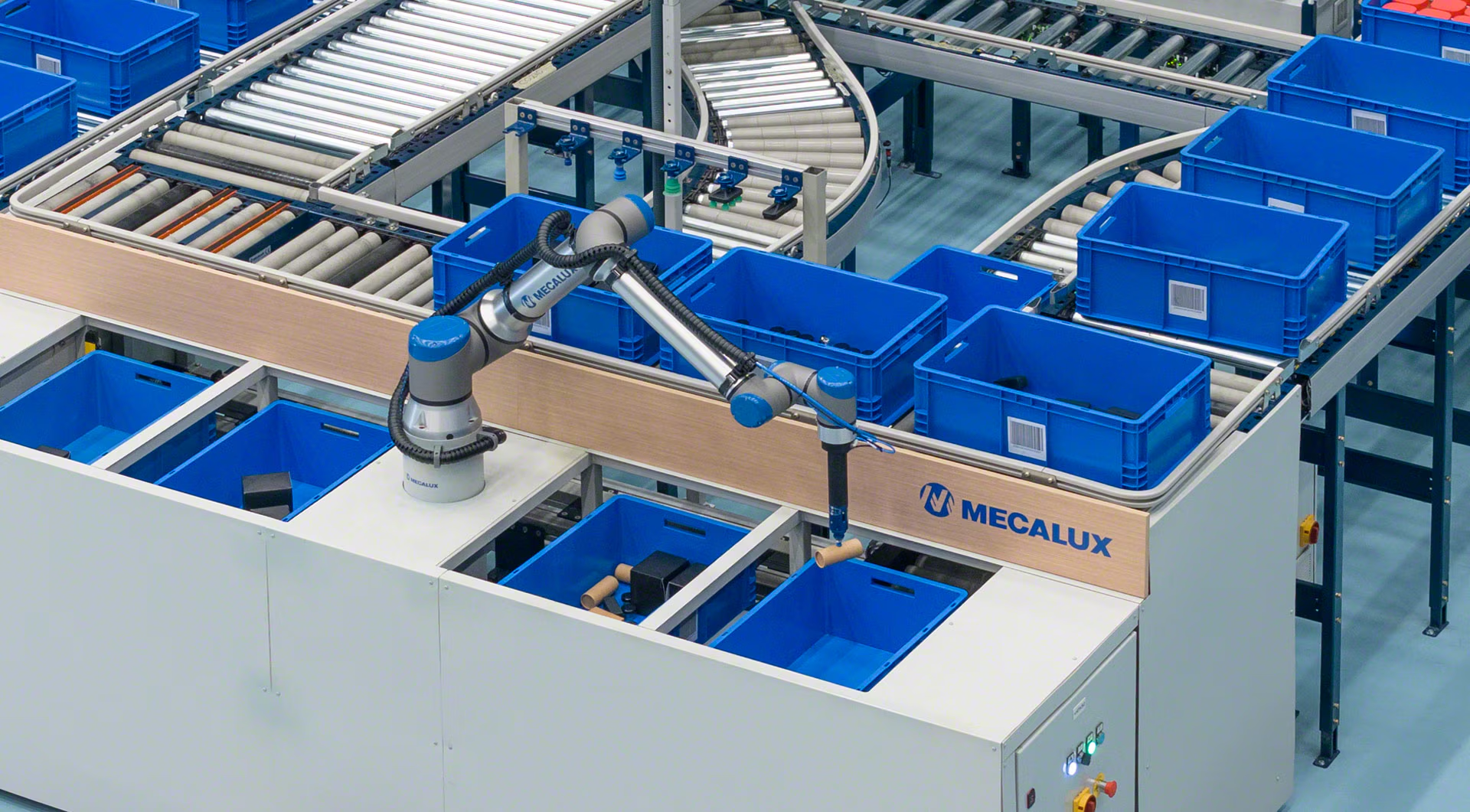
1. Warehouse & Logistics Automation
Clawdbot can:
-
Pick and place items
-
Sort packages
-
Handle irregularly shaped goods
Unlike fixed robotic arms, it adapts to constantly changing inventory.
2. Manufacturing & Assembly Lines
In factories, Clawdbot helps with:
-
Component handling
-
Quality inspection assistance
-
Flexible assembly tasks
This reduces downtime when product designs change.
3. Waste Management & Recycling
One of the most promising areas:
-
Identifying recyclable materials
-
Sorting waste efficiently
-
Reducing human exposure to hazardous materials
AI-driven claws excel in these unpredictable environments.
4. Healthcare & Labs
In controlled settings, Clawdbot can:
-
Transport medical supplies
-
Handle lab samples
-
Assist in sterile environments
Precision + repeatability make it ideal here.
5. Retail & Fulfillment Centers
From order picking to restocking, Clawdbot enables:
-
Faster fulfillment
-
Reduced errors
-
24/7 operations
How Clawdbot Differs From Traditional Robots
| Feature | Traditional Robots | Clawdbot |
|---|---|---|
| Programming | Rule-based | Learning-based |
| Adaptability | Low | High |
| Object Variety | Limited | Wide |
| Environment | Controlled | Dynamic |
| Learning | None | Continuous |
In short, Clawdbot behaves less like a machine and more like a physical AI agent.
Clawdbot and the Rise of Physical AI Agents
Clawdbot fits into a broader trend: embodied intelligence.
This means AI systems that:
-
Perceive the world
-
Reason about it
-
Act within it
Unlike chatbots or software agents, Clawdbot operates where mistakes have physical consequences, making reliability and learning critical.
This is the same philosophical shift driving:
-
Autonomous vehicles
-
Humanoid robots
-
AI-powered drones
Benefits of Clawdbot
✅ Increased Efficiency
Performs repetitive tasks faster than humans.
✅ Reduced Labor Dependency
Helps address workforce shortages.
✅ Scalability
Deploy once, replicate across locations.
✅ Continuous Improvement
Learns from every interaction.
✅ Safety
Handles dangerous or hazardous tasks.
Challenges and Limitations
Despite its promise, Clawdbot isn’t magic.
⚠️ High Initial Cost
Advanced robotics and AI aren’t cheap to deploy.
⚠️ Training Data Requirements
Robots need extensive data to generalize well.
⚠️ Edge Case Failures
Highly unusual objects can still confuse the system.
⚠️ Integration Complexity
Existing infrastructure may need upgrades.
Ethical and Workforce Implications
As with any automation technology, Clawdbot raises important questions:
-
Will it replace human jobs or augment them?
-
Who is responsible when an autonomous robot fails?
-
How do we regulate physical AI systems?
Most experts agree the near-term future is collaboration, not replacement—robots handle repetitive tasks while humans focus on supervision and creativity.
Clawdbot vs Humanoid Robots
Clawdbot is purpose-built, not general-purpose.
Humanoid robots aim to mimic humans broadly.
Clawdbot focuses on doing one category of tasks extremely well.
This makes it:
-
Cheaper
-
More reliable
-
Easier to deploy today
The Future of Clawdbot
Looking ahead, we can expect Clawdbot systems to:
-
Gain better tactile sensing
-
Learn faster with fewer examples
-
Collaborate with other robots
-
Integrate with AI agents and enterprise software
Eventually, fleets of Clawdbots could operate as coordinated autonomous teams, sharing knowledge in real time.
Is Clawdbot a Glimpse of the Post-Human Workforce?
Not post-human—but post-manual-repetition.
Clawdbot represents a future where:
-
Machines handle the dull, dirty, and dangerous
-
Humans supervise, design, and innovate
-
AI and robotics work as teammates, not tools
Final Thoughts
Clawdbot is more than just a robot with a claw.
It’s a symbol of where AI is heading—out of screens and into the physical world.
By combining adaptive intelligence with precise mechanical control, Clawdbot shows how automation can finally handle the complexity of real environments. While challenges remain, its rapid progress suggests that physical AI agents are no longer science fiction—they’re becoming infrastructure.
If software AI transformed how we think, Clawdbot-style robots will transform how we work.
For quick updates, follow our whatsapp –https://whatsapp.com/channel/0029VbAabEC11ulGy0ZwRi3j
https://bitsofall.com/flashlabs-chroma-1-0-voice-ai/
https://bitsofall.com/what-are-context-graphs/
Apple Siri Overhaul — what’s changing, why it matters, and what to expect