Natural Language Processing (NLP) in 2025: Transforming How Humans and Machines Talk
Introduction
In a world increasingly run by machines, communication remains the most human thing we do. Enter Natural Language Processing (NLP)—the AI technology that bridges the gap between human language and machine understanding.
From Google Search autocomplete to ChatGPT conversations, NLP powers the smart applications we use daily. And in 2025, it’s no longer just a backend technology—it’s the beating heart of every intelligent interaction.
This blog explores what NLP is, how it works in 2025, key breakthroughs, industry applications, top tools, ethical concerns, and what’s coming next.
What is Natural Language Processing (NLP)?
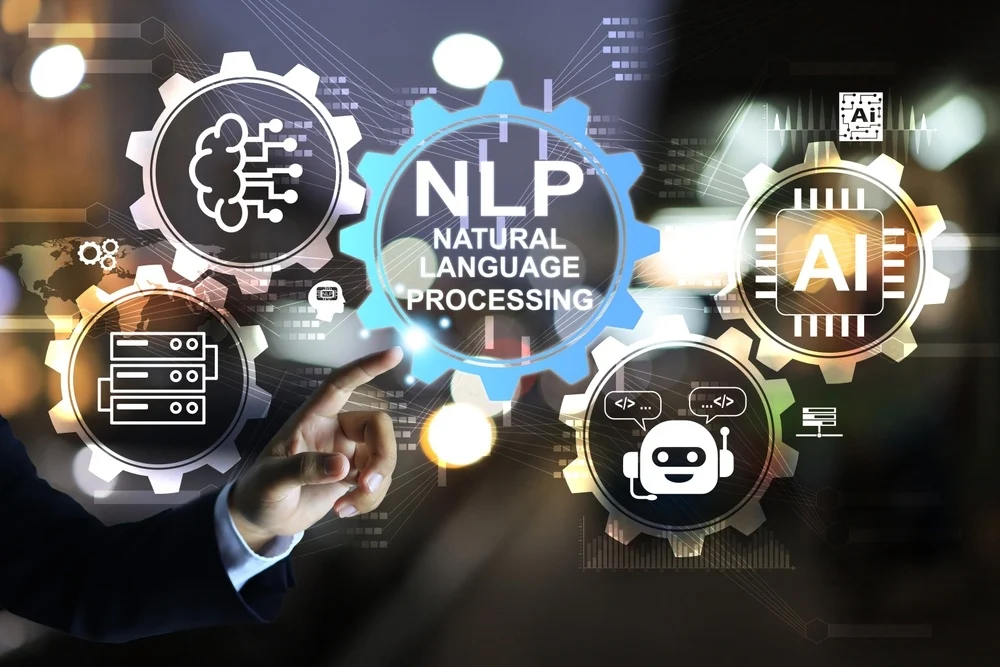
Natural Language Processing is a subfield of artificial intelligence (AI) and linguistics that enables machines to understand, interpret, and generate human language—spoken or written.
NLP focuses on tasks like:
-
Speech recognition
-
Text classification
-
Language translation
-
Sentiment analysis
-
Question answering
-
Named Entity Recognition (NER)
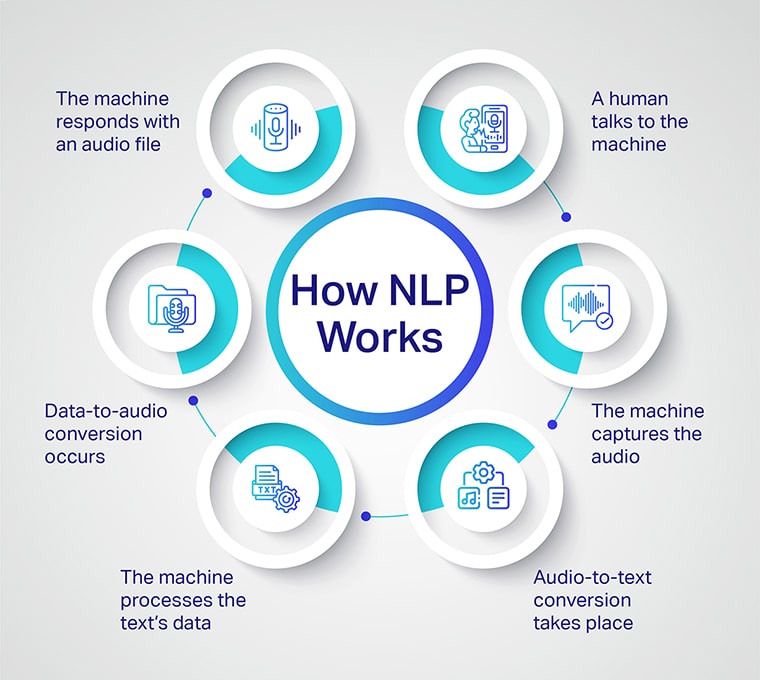
It turns messy human language into structured data machines can process—and vice versa.

How NLP Works: Core Components in 2025
Modern NLP systems rely on a combination of deep learning, transformers, and vast amounts of training data. The following components form the foundation:
1. Tokenization
Breaking text into individual words or phrases.
2. Part-of-Speech Tagging (POS)
Labeling words as nouns, verbs, adjectives, etc.
3. Named Entity Recognition (NER)
Identifying people, places, organizations in a sentence.
4. Parsing & Syntax Trees
Analyzing grammatical structure.
5. Semantic Analysis
Understanding meaning and context beyond literal words.
6. Language Modeling
Predicting the next word in a sentence using neural networks (e.g., GPT-4o, Claude, Gemini).
NLP Breakthroughs in 2025
The field has matured rapidly in recent years. Here’s what’s new in NLP as of 2025:
1. Multimodal NLP
Models now combine text, audio, image, and video—enabling rich conversational AI with contextual understanding.
Example: GPT-4o processes images + text + voice in real time.
2. Few-shot & Zero-shot Learning
Modern NLP models require far less training data and can perform tasks they weren’t explicitly trained on.
3. Real-Time Multilingual Translation
Real-time AI translators (like Meta’s SeamlessM4T or Google’s Universal Translator) offer instant, fluent translation across 100+ languages.
4. Emotion-Aware NLP
Sentiment analysis now includes emotion gradients, understanding sarcasm, humor, and tone more accurately.
5. On-Device NLP
With chip advances, NLP models now run offline on smartphones, ensuring privacy and faster performance.
Top Applications of NLP in 2025
💬 1. AI Chatbots and Virtual Assistants
Tools like ChatGPT, Google Gemini, and Claude use NLP to carry out natural, meaningful conversations.
Use cases:
-
Customer service (24/7)
-
Medical assistants
-
HR onboarding
-
Legal helpbots
🔍 2. Semantic Search
Unlike keyword-based search, semantic search understands intent.
Used by:
-
Google Search
-
Enterprise knowledge bases
-
E-commerce recommendation engines
📊 3. Sentiment Analysis
Used by:
-
Brands for customer feedback
-
Politicians for campaign monitoring
-
Investors tracking public sentiment on stocks
📄 4. Document Summarization
NLP condenses long articles, legal documents, and scientific research into readable summaries.
🧏 5. Speech Recognition & Transcription
NLP enables tools like Otter.ai, Zoom AI Companion, and Apple’s new voice journal app to transcribe spoken content into accurate, searchable text.
🌍 6. Machine Translation
From Google Translate to Meta AI models, NLP is erasing language barriers across media, commerce, and diplomacy.
Top NLP Tools & Frameworks in 2025
Here are the most powerful tools and APIs for developers and businesses:
| Tool/Framework | Purpose | Notes |
|---|---|---|
| spaCy | Text processing, NER | Lightweight, fast |
| NLTK | Academic NLP tasks | Great for prototyping |
| Transformers (Hugging Face) | Pre-trained LLMs | BERT, GPT, RoBERTa, etc. |
| OpenAI GPT-4o | Conversational AI | Multimodal & fast |
| Google Cloud NLP | Enterprise NLP APIs | Supports text & doc analysis |
| Amazon Comprehend | Sentiment, translation | Built for enterprise scalability |
| Cohere NLP APIs | Lightweight LLMs | Great for summarization |
| AssemblyAI / Whisper | Speech-to-text NLP | Powerful audio transcription |
⚖️ Ethical Concerns in NLP
⚠️ 1. Bias in Language Models
Models like GPT can inherit and amplify bias—sexism, racism, political slant—present in their training data.
Solution: Debiasing datasets, diverse training sources, fairness testing.
⚠️ 2. Privacy Risks
NLP systems trained on real-world data (e.g., emails, chats) risk violating user privacy.
Solution: Federated learning, anonymization, on-device processing.
⚠️ 3. Misinformation and Fake Content
NLP-generated deepfakes and fake news articles can spread rapidly.
Solution: Content watermarking, detection algorithms, ethical use guidelines.

Industries Transformed by NLP
Education
-
Smart tutoring assistants
-
Essay feedback systems
-
Multilingual teaching tools
Healthcare
-
Medical note summarization
-
Doctor-patient chatbot assistants
-
Voice dictation for EMRs
E-commerce
-
Product description generation
-
Review analysis
-
Multilingual customer support
Government & Policy
-
Public feedback analysis
-
Multilingual civic bots
-
Legal document summarization
Finance
-
Real-time news sentiment monitoring
-
Document automation
-
Fraud detection through language anomalies
The Future of NLP Beyond 2025
Here’s what lies ahead:
1. Self-aware NLP agents
Systems that understand context, goals, and personas.
2. Cross-cultural NLP
Emotion-aware translation that preserves tone, idioms, and sentiment.
3. Personalized NLP
AI that adapts to your communication style—tone, vocabulary, even humor.
4. Quantum NLP
Early research shows quantum computing may dramatically accelerate NLP inference tasks.
❓ FAQs about Natural Language Processing
Q1. What is the difference between NLP and NLU?
NLP is the broader field that includes both language understanding (NLU) and generation (NLG). NLU focuses on interpreting meaning, while NLP includes all processing steps.
Q2. What are common NLP tasks?
Text classification, sentiment analysis, summarization, translation, speech recognition, and chatbot interactions.
Q3. Which companies are leading in NLP?
OpenAI, Google, Meta, Microsoft, Cohere, Hugging Face, Amazon, and NVIDIA.
Q4. Can I use NLP without coding?
Yes! Tools like ChatGPT, Jasper, Writer, and Google Cloud NLP offer no-code interfaces to NLP.
Q5. Is NLP safe to use for sensitive tasks like healthcare or law?
It can be—if combined with human oversight, proper testing, privacy safeguards, and regulatory compliance.
🧩 Conclusion
In 2025, Natural Language Processing is the linchpin of intelligent communication between humans and machines. From powering your AI assistant to decoding customer sentiment or translating speech in real time—NLP is everywhere.
But with great power comes great responsibility. Developers, businesses, and users must treat NLP not just as a technical tool, but as a social force—capable of shaping how we think, talk, and understand each other.
If AI is the engine, NLP is the language we use to drive it.