Horizontal AI: The General-Purpose Intelligence Powering Multiple Industries
Introduction
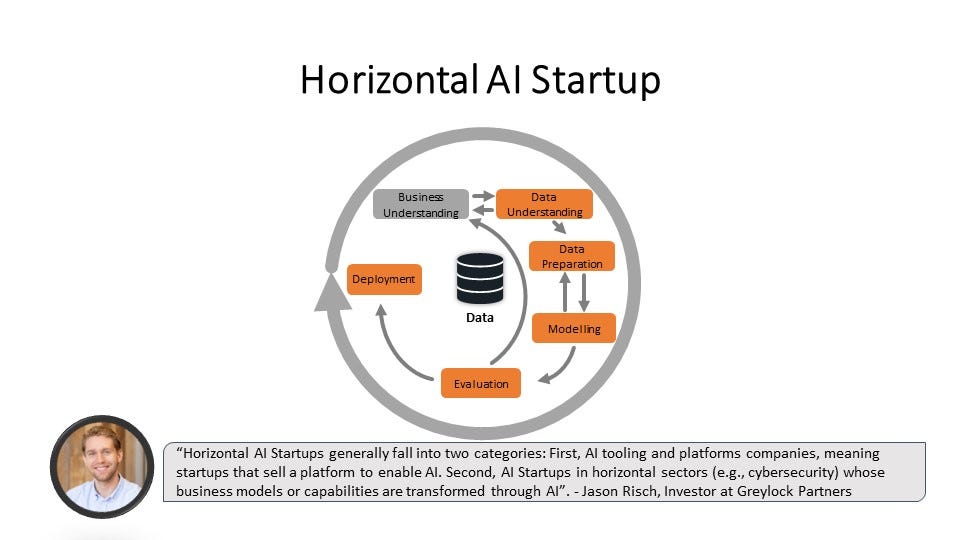
Artificial Intelligence (AI) has rapidly evolved from a niche research field into a core business driver for industries worldwide. In this evolution, two main categories have emerged — Horizontal AI and Vertical AI.
While Vertical AI focuses on specialized solutions for a single industry (like AI for healthcare or AI for finance), Horizontal AI is designed to work across multiple sectors. It offers general-purpose AI capabilities — like language processing, image recognition, and predictive analytics — that can be applied in different contexts without being tied to a single domain.
From chatbots that can assist customers in any business to analytics platforms that forecast trends in retail, banking, or healthcare, Horizontal AI is the versatile backbone of modern AI adoption.
What is Horizontal AI?
Horizontal AI refers to AI technologies that are not industry-specific but instead designed to solve broad, cross-sector challenges. These solutions are platforms, tools, or models that can be applied to multiple industries with little to moderate customization.
Key characteristics of Horizontal AI:
-
Versatility – Can be adapted to different industries and tasks.
-
Scalable architecture – Works with various datasets and applications.
-
Reusable models – Pre-trained AI models can be fine-tuned for specific uses.
-
Broad adoption – Found in customer service, marketing, operations, finance, and more.
Example:
-
ChatGPT by OpenAI — A conversational AI capable of assisting in customer service, education, programming help, marketing copywriting, and more.
-
Google Vision API — Can analyze images for retail product tagging, medical imaging, or security surveillance.
Horizontal AI vs. Vertical AI
To understand Horizontal AI better, let’s compare it with Vertical AI.
| Feature | Horizontal AI | Vertical AI |
|---|---|---|
| Scope | Broad, cross-industry | Narrow, industry-specific |
| Training Data | General datasets from diverse domains | Domain-specific datasets |
| Use Cases | Customer support, generic analytics, document processing | Medical imaging, fraud detection, crop monitoring |
| Customization Needs | Moderate | High |
| Speed of Deployment | Faster (less industry-specific tuning) | Slower (requires deep customization) |
| Examples | ChatGPT, IBM Watson Assistant, Microsoft Azure AI | Aidoc (healthcare), Zest AI (finance) |
Why Horizontal AI Matters
The appeal of Horizontal AI lies in its flexibility, cost-effectiveness, and scalability.
-
Lower Development Costs – One AI system can serve multiple industries, reducing the need for specialized builds.
-
Faster Deployment – Ready-to-use models can be integrated quickly with minimal adaptation.
-
Innovation Acceleration – Businesses can experiment with AI applications without having to invest in fully custom solutions.
-
Cross-Industry Knowledge Transfer – AI learns from patterns across domains, improving decision-making.
Core Capabilities of Horizontal AI
Horizontal AI provides a set of foundational capabilities that businesses can use across different contexts.
1. Natural Language Processing (NLP)
Enables machines to understand, interpret, and generate human language.
-
Chatbots for customer support in retail, banking, healthcare, etc.
-
Language translation tools for international operations.
-
Sentiment analysis for brand monitoring.
2. Computer Vision
Processes and analyzes images and videos.
-
Retail: Automated product tagging.
-
Security: Facial recognition in surveillance.
-
Healthcare: Preliminary image analysis for scans.
3. Predictive Analytics
Uses statistical models and machine learning to forecast future events.
-
Finance: Market trend prediction.
-
Manufacturing: Demand forecasting.
-
Logistics: Supply chain optimization.
4. Speech Recognition
Converts spoken language into text.
-
Call centers: Automatic transcription.
-
Voice assistants like Alexa or Google Assistant.
-
Medical: Dictation tools for doctors.
5. Robotic Process Automation (RPA)
Automates repetitive, rules-based tasks.
-
HR: Resume screening.
-
Finance: Invoice processing.
-
IT: Automated software testing.
Examples of Horizontal AI in Action
1. Microsoft Azure AI
Azure AI services offer vision, speech, language, and decision-making APIs that can be integrated into applications in any sector.
2. IBM Watson Assistant
Used for customer service chatbots in industries ranging from healthcare to hospitality.
3. Salesforce Einstein
Provides AI-powered CRM insights applicable to any business type.
Benefits of Horizontal AI
1. Versatility
Works across industries without needing a completely new system for each sector.
2. Rapid Scaling
Easily deployed in new departments or locations without major re-engineering.
3. Cost Savings
Shared development and infrastructure reduce overall AI investment.
4. Continuous Learning
Models improve over time using data from multiple industries.
Challenges of Horizontal AI
1. Lack of Deep Domain Knowledge
While flexible, horizontal AI often lacks the specific expertise needed for niche problems.
2. Generic Output Risk
May produce less precise results than vertical AI in specialized scenarios.
3. Data Privacy Compliance
A cross-industry model must meet varying compliance requirements, which can be complex.
4. Customization Costs
Although easier to deploy, adapting horizontal AI for optimal performance in a specific industry still requires investment.
Best Practices for Implementing Horizontal AI
-
Identify Common Use Cases Across the Organization
Focus on processes that are similar across departments, like customer support or data entry. -
Choose Modular AI Platforms
Select AI solutions with APIs and integrations for easy adaptation. -
Combine with Vertical AI When Necessary
Use horizontal AI as a foundation and layer vertical AI for domain-specific expertise. -
Prioritize Explainability
Ensure AI outputs can be explained for trust and compliance. -
Maintain Data Security
Implement strong privacy measures to handle diverse datasets.
The Role of Horizontal AI in Digital Transformation
Horizontal AI is a key enabler of enterprise-wide digital transformation because it:
-
Unifies AI capabilities across business functions.
-
Creates consistent data insights across industries.
-
Allows rapid experimentation with new AI-driven solutions.
Future Trends in Horizontal AI
1. Foundation Models for Everything
Large Language Models (LLMs) like GPT-5 will evolve into multi-modal foundation models capable of text, image, video, and audio understanding for any industry.
2. AI-as-a-Platform
More companies will adopt AI platforms that can be customized for different sectors without starting from scratch.
3. Industry-Agnostic AI Marketplaces
Businesses will purchase pre-built horizontal AI modules from marketplaces and integrate them instantly.
4. Hybrid AI
Combination of horizontal AI’s flexibility and vertical AI’s precision will become the dominant approach.
Case Study: Horizontal AI in Customer Experience
Company: A global telecommunications provider
Challenge: Improve customer service across multiple regions and languages.
Solution: Implemented a horizontal AI-powered chatbot platform capable of:
-
Understanding multiple languages (NLP).
-
Integrating with CRM for real-time account details.
-
Escalating complex cases to human agents.
Result: Reduced customer wait times by 40%, improved satisfaction scores by 25%.
Horizontal AI and Industry Collaboration
One of the strongest advantages of horizontal AI is knowledge sharing across sectors. For example:
-
Fraud detection patterns learned in banking can help e-commerce platforms identify fraudulent transactions.
-
NLP improvements in healthcare documentation can improve customer support automation in retail.
Risks and Ethical Considerations
Even though horizontal AI is general-purpose, it still faces ethical challenges:
-
Bias Transfer — A model trained on broad datasets may carry biases into all industries it serves.
-
Security Vulnerabilities — A widely used AI platform becomes a high-value target for cyberattacks.
-
Job Displacement — Automation of repetitive tasks may reduce certain job roles.
Conclusion
Horizontal AI is the Swiss Army knife of artificial intelligence — flexible, scalable, and applicable across industries. While it may not have the deep specialization of vertical AI, its ability to quickly adapt and serve multiple sectors makes it a critical tool for businesses seeking rapid AI adoption.
The future will likely see horizontal AI continue to grow as the foundation for enterprise-wide AI strategies, with vertical AI layered on top for domain-specific excellence. Organizations that master the combination of both will have a strategic advantage in innovation, efficiency, and adaptability.
https://bitsofall.com/ai-in-cybersecurity/
Vertical AI Integration: Transforming Industries with Specialized Intelligence