Google DeepMind Introduces SIMA 2 — A Gemini-Powered Generalist Agent for Complex 3D Virtual Worlds
Short summary: In November 2025 DeepMind unveiled SIMA 2, the follow-up to its Scalable Instructable Multiworld Agent (SIMA). SIMA 2 pairs a generalist embodied-agent architecture with Google’s Gemini reasoning stack and a synthetic “world-model” training pipeline to operate, plan, and self-improve inside richly interactive 3D game worlds. The result is an agent that can interpret high-level goals, explain its reasoning, generate and attempt its own curricula, and transfer skills across previously unseen virtual environments — a meaningful step toward embodied, generalist intelligence and a pragmatic testbed for future robotics. Google DeepMind+2TechCrunch+2
Why SIMA 2 matters
Research on AI agents that can act in the world — virtual or physical — has long been central to the roadmap for more general intelligence. Games and simulated 3D worlds provide richly structured environments where perception, planning, long-horizon control, exploration, and social interaction can be studied at scale. SIMA 2 stands out for three reasons:
-
Integration of a large reasoning model (Gemini) with an embodied agent. This lets SIMA 2 reason about goals and plans in natural language and multimodal inputs, not just map observations to actions. TechCrunch
-
Self-improvement through synthetic curricula. Rather than relying only on human demonstrations, SIMA 2 uses automated task generation and evaluation to create diverse, targeted training episodes — accelerating learning in many domains. AICERTs – Empower with AI Certifications+1
-
Cross-world generalization in complex 3D games. The agent has been demonstrated on a broad variety of titles (from survival and crafting games to open exploration worlds), showing transfer to previously unseen game mechanics and affordances. That’s a higher bar than classic RL benchmarks. The Verge+1
These capabilities make SIMA 2 not merely a better game-playing bot but an experimental platform to probe how scalable embodied intelligence can be made to learn, explain, and adapt.
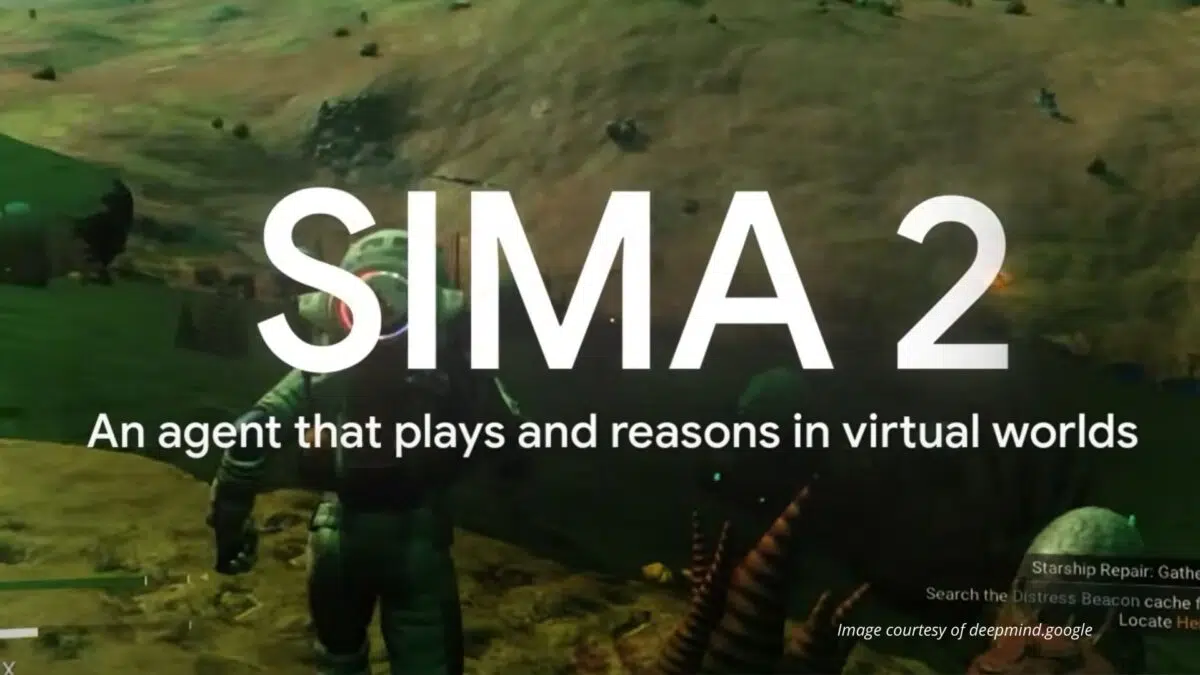
What SIMA 2 is — architecture and training (high level)
SIMA 2 is an evolution of the original SIMA framework DeepMind introduced in 2024. The architecture remains a generalist embodied agent designed to operate across multiple games and simulated worlds, but key changes were introduced:
-
Gemini as the reasoning core. SIMA 2 hooks into Gemini, a large multimodal model (LMM) tuned for planning, language, and multimodal reasoning. Gemini supplies high-level task interpretation, stepwise reasoning (think: “how would a human plan this?”), and natural-language explanations that can be used for debugging and human-in-the-loop control. Google DeepMind+1
-
Perception + action loop. The agent still relies on visual/egocentric observations from the game engine, a state-encoder that turns pixels and game state into embeddings, and a policy head that issues low-level motor/interaction commands. But the policy is now guided by Gemini’s reasoning traces and goal priors, improving long-horizon coherence.
-
Synthetic world models and self-training. DeepMind’s family of world models (examples: Genie/Genie 2) produce simulated scenarios and label data for training. Gemini and the world model collaboratively propose tasks, estimate rewards, and grade attempts; SIMA 2 then practices those tasks, learns from failures, and iterates — effectively generating its own curriculum. This reduces dependence on costly human annotations. Google DeepMind+1
-
Evaluation across many games. Instead of focusing on a single benchmark, SIMA 2 is benchmarked across a diverse set of 3D titles with different physics, goals, and rule sets. That diversity is what lets researchers probe whether the agent truly generalizes. MarkTechPost+1
Demonstrations: what SIMA 2 can do today
DeepMind released videos and technical notes showing SIMA 2 performing multi-step, open-ended tasks in complex games. Representative capabilities include:
-
Long-horizon planning: SIMA 2 breaks down high-level goals (e.g., “build a functioning base and make a boat”) into subgoals, sequences actions appropriately, and adapts when the environment changes. This planning is informed by Gemini’s chain-of-thought style reasoning. TechCrunch
-
Tool use and crafting: In crafting-heavy games (where you must find resources, combine items, and use the right tool at the right time), SIMA 2 learned multi-step crafting pipelines rather than relying on simple reactive heuristics. The Verge
-
Exploration + curiosity: The self-generated curricula encourage varied exploration strategies, which helps the agent discover affordances (like climbing, swimming, or using dynamic physics objects) and exploit them when needed. AICERTs – Empower with AI Certifications
-
Adaptation to novel mechanics: When introduced to previously unseen games or rule changes, SIMA 2 has shown improved transfer compared to models trained on narrower datasets, pointing to better abstraction capabilities. MarkTechPost
DeepMind stresses that these are controlled research demonstrations — SIMA 2 is not a consumer product, but a research platform.
How the self-improvement loop works (in plain terms)
One of SIMA 2’s more intriguing mechanisms is its self-improvement pipeline. Here’s a simplified version of how it operates:
-
Task proposal: Gemini (or a synthetic curriculum module) proposes tasks or goals that are likely to be informative for the agent. These can be simple (“collect 10 wood”) or complex composites (“build shelter, then block a lava flow”). Google DeepMind+1
-
Attempt & record: SIMA 2 attempts the task inside the simulated world. Its sensors log observations, actions, and outcomes. AICERTs – Empower with AI Certifications
-
Automated evaluation: The world model or Gemini evaluates the attempt, assigns a reward/score, and — crucially — analyzes failure modes (“agent couldn’t craft because lacked an axe”). Google DeepMind+1
-
Curriculum update: Based on evaluations, the system generates follow-up training episodes that address weaknesses (e.g., simulate more axe-finding scenarios). SIMA 2 trains on these, improving iteratively. AICERTs – Empower with AI Certifications
This loop is powerful because it multiplies the effective training signal without linear human supervision, enabling breadth and depth of experience.

Immediate applications and research value
SIMA 2 is primarily a research milestone, but it unlocks several near-term use cases and research pathways:
-
Robotics simulation to reality (sim2real): Rich 3D virtual training can produce policies and curricula that bootstrap real-world robot learning, especially for navigation and object manipulation tasks that are expensive or risky to experiment with physically. World models like Genie serve as intermediaries to create plausible physics and interactions. Google DeepMind
-
Game AI and adaptive NPCs: Game studios could use SIMA-style agents to create NPCs that learn from players, adapt to emergent playstyles, and remain engaging long after release. The self-improvement loop enables continuous learning in live service games. AICERTs – Empower with AI Certifications
-
Training and simulation for hazardous tasks: Virtual agents that can safely explore edge cases in disaster, logistics, or industrial scenarios could accelerate staff training and scenario planning without real-world risk. AICERTs – Empower with AI Certifications
-
Scientific study of generalization: SIMA 2 provides a testbed for research into transfer learning, multi-task curricula, and embodied reasoning — key scientific problems en route to more general intelligence. MarkTechPost
Safety, alignment, and limitations
DeepMind and other commentators emphasize that SIMA 2’s capabilities are still bounded and that many safety and alignment questions remain:
-
Domain gap to the physical world. Performance inside simulated 3D games doesn’t automatically transfer to the messiness of physical environments. Sensors, noisy actuation, and safety constraints in real robots remain substantial hurdles. SIMA 2 reduces a part of the gap but does not close it. Google DeepMind
-
Evaluation robustness. Large-scale demonstrations can be suggestive, but rigorous, adversarial testing is required to ensure robust generalization. Metrics that look good on curated task suites may not capture brittle failure modes. Independent benchmarks and reproducibility will be important. TechCrunch
-
Autonomous goal generation risks. The self-improvement loop that lets the agent generate its own tasks must be constrained: unconstrained goal invention could produce pathological curricula or behavior that optimizes proxy metrics without delivering intended competence. Principled reward design and oversight are necessary. AICERTs – Empower with AI Certifications
-
Dual-use concerns. Powerful embodied agents could be misapplied (e.g., for automated game-cheating ecosystems, malicious automation inside simulated testbeds, or scaled content generation that misleads users). Transparent release policies, red-team testing, and access controls are crucial. Google DeepMind+1
DeepMind has framed SIMA 2 as a research tool released to “select academics and developers” rather than the public at large — a step intended to balance scientific progress with careful rollout. The Verge
How SIMA 2 fits into the broader AI landscape
SIMA 2 is not an isolated novelty but sits at the intersection of several concurrent trends:
-
Large multimodal reasoning models (Gemini, GPT-style LMMs) being used as controllers and planners, not just text generators. This trend blurs the line between “reasoning” and “control.” TechCrunch
-
World models that synthesize environments (Genie series) enabling cheaper, scalable, and more diverse training curricula for embodied agents. These models create new options for zero-shot or few-shot skill acquisition. Google DeepMind
-
Self-supervised and synthetic-data training pipelines reducing dependency on manual labeling and on narrowly defined benchmarks. SIMA 2’s automated curriculum generation exemplifies this. AICERTs – Empower with AI Certifications
-
Industry competition around embodied AGI research, with major labs (Google/DeepMind, OpenAI, Anthropic, Meta) racing to show agents that exhibit generality across modalities and tasks. SIMA 2 marks a public milestone in that race. The Verge
Taken together, these trends suggest a near-term research environment where agents increasingly learn from simulated worlds built by world models and reason about actions via large reasoning models — a pipeline that could scale rapidly if the technical and governance challenges are handled responsibly.
What to watch next
If you’re following this area, key developments to monitor include:
-
Peer-reviewed technical details and benchmarks. DeepMind’s blog and supplementary materials are useful, but independent replication and rigorous benchmarks will be decisive for assessing true generality. Google DeepMind+1
-
Sim2real experiments. Any demonstration where SIMA-derived policies are deployed on physical robots or hardware will be a major step. Watch for robotics papers and demos tied to SIMA/Genie pipelines. Google DeepMind
-
Access policies and dataset disclosures. How widely DeepMind shares models, world models, and synthetic data will shape research accessibility and community scrutiny. Google DeepMind
-
Safety audits and red-team results. Independent safety audits, adversarial evaluations, and governance documentation will reveal how responsibly these capabilities are being developed. Google DeepMind
Conclusion — a pragmatic leap, not a magic bullet
SIMA 2 is an important research milestone: it couples a powerful multimodal reasoning system (Gemini) with embodied agent control and a synthetic world-model training loop to push generalization and long-horizon competence inside challenging 3D environments. The demonstrations are impressive and suggest real progress toward agents that can reason, plan, and learn in rich environments — a necessary ingredient for future robotic and AGI systems. Google DeepMind+1
However, SIMA 2 is not an instant route to mature general artificial intelligence or safe, autonomous real-world robots. Important questions about sim2real transfer, safety, robustness, and governance remain. As with many ambitious AI milestones, the value lies in the new research avenues it opens and the tests it enables, not in any single demo. The coming months will reveal whether SIMA 2’s synthesis of reasoning, world modeling, and self-training scales into broadly useful, safe embodied intelligence — and whether the research community can rigorously evaluate and build on DeepMind’s work. The Verge+1
Sources & further reading (high-level): DeepMind’s SIMA 2 blog post and research notes; contemporary reporting by TechCrunch, The Verge, and other outlets covering DeepMind’s November 2025 release. For technical background on world models see DeepMind’s Genie papers. Google DeepMind+3Google DeepMind+3TechCrunch+3
For quick updates, follow our whatsapp –https://whatsapp.com/channel/0029VbAabEC11ulGy0ZwRi3j
https://bitsofall.com/mbzuai-researchers-introduce-pan-general-world-model/
NVIDIA AI Introduces TiDAR — “Think in Diffusion, Talk in Autoregression”
Meta AI Releases Omnilingual ASR — A Breakthrough for Speech Technology