Google AI Releases Universal Commerce Protocol (UCP): An Open-Source Standard Designed to Power the Next Generation of Agentic Commerce
The way we shop online is on the cusp of a fundamental change — not just better recommendations or faster search, but AI systems that can act for us: discover options, compare alternatives, negotiate terms, place orders, and manage post-purchase follow-up. Today, Google and a coalition of retailers, payment providers, and platform partners launched the Universal Commerce Protocol (UCP), an open-source, Apache-licensed standard intended to make those “agentic” shopping experiences interoperable, secure, and trustworthy across the web. UCP is designed to be the common language between consumer AI surfaces (like chat-based assistants), merchant systems (catalogs, inventory, fulfillment), and payment and credential providers — reducing the need for custom integrations and making it easier for AI agents to complete entire commerce journeys.
This article explains what UCP is, the technical ideas behind it, who’s already on board, why merchants and platforms care, how payments and security are being addressed, what user and regulatory risks remain, and how UCP might shape the future of commerce when software increasingly acts on behalf of people.
What is the Universal Commerce Protocol (UCP)?
At its core, UCP is a standardized API and schema set that models commerce as a set of interoperable actions and events: product discovery, price & availability negotiation, cart construction, checkout authorization, fulfillment orchestration, and post-purchase support (returns, tracking, subscriptions). Instead of every AI assistant having to build a bespoke integration to each merchant or payments provider, UCP provides a set of functional primitives — well-defined messages, intents, and data formats — that let agents and platforms communicate with merchants and service providers in a consistent way. The protocol is available as an open project with reference implementations and SDKs on GitHub.
Google frames UCP as a way to enable “agentic commerce”: interactions in which an AI system executes multi-step commerce tasks on behalf of a user across platforms while preserving merchant control and consumer safety. Practically, that could mean your assistant finds the exact lamp you liked, checks inventory across sellers, applies any available discounts, initiates payment, schedules delivery, and follows up when the item ships — all without the user copying links or switching apps.
Why an open standard? The fragmentation problem
Today’s commerce landscape is fragmented: marketplaces, direct-to-consumer storefronts, and point-of-sale systems expose very different APIs; payment flows and identity fields vary widely; and each assistant (or platform) that wants to “shop” needs bespoke integration work. That creates high engineering cost and brittle user experiences — agentic shopping often breaks at checkout or loses important merchant metadata (like return policies). An open standard reduces friction by making those interactions predictable and reusable across vendors. The UCP initiative explicitly targeted this fragmentation by producing a spec, SDKs, and sample implementations to drive broad adoption.
Who’s building and adopting UCP?
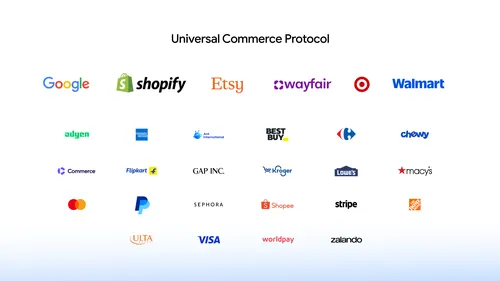
Google co-developed UCP with a broad set of industry partners. Early adopters and collaborators include major retailers and platform companies such as Shopify, Etsy, Wayfair, Target, Walmart — and financial players like Visa, Mastercard and PayPal have been listed among participants supporting secure payments integration. Enterprise software vendors and commerce platforms (for example, announcements indicate Shopify and Salesforce are building integrations) have also signaled support; that breadth is intended to help UCP work across small merchants and global enterprises alike.
These partnerships are critical: interoperability works only if both sides speak the same language. Google will support UCP within its consumer AI surfaces (AI Mode in Search and the Gemini app), which means UCP-compliant merchants can be discoverable and directly transactable inside Google’s conversational experiences — a major distribution channel for merchants who adopt the standard.
Technical design: primitives, events, and extensibility
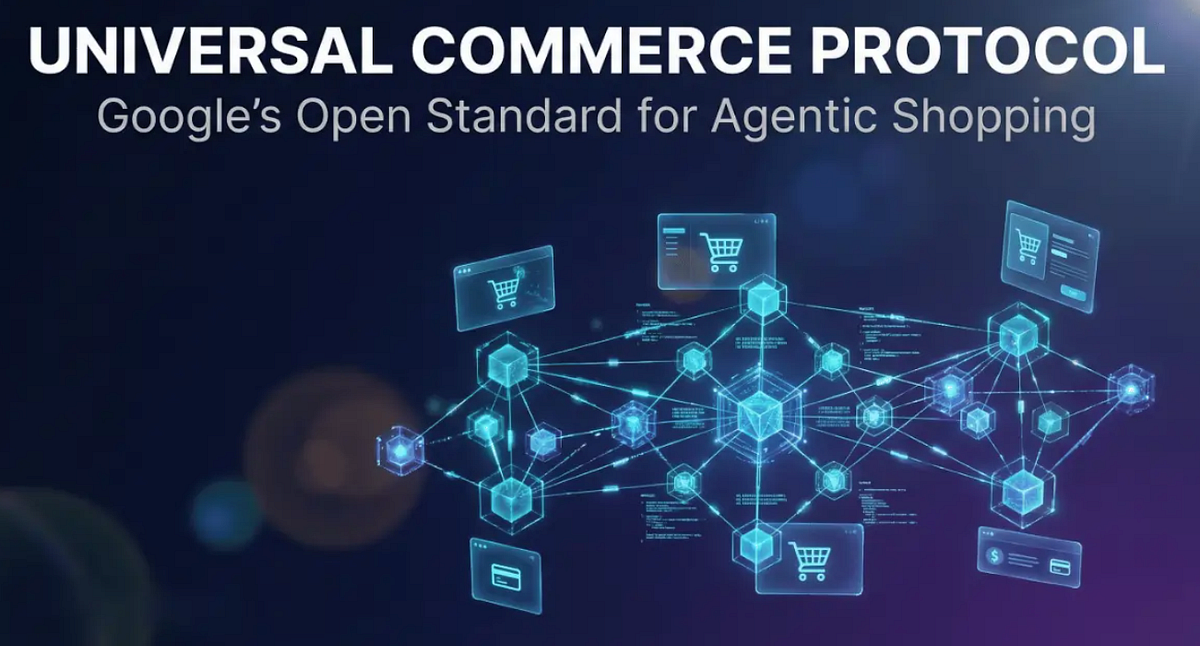
UCP’s design is pragmatic: it defines core building blocks (primitives) such as Offer, Cart, PaymentInstrument, FulfillmentInstruction, and CredentialReference. The protocol models the lifecycle of a commerce interaction as events and messages (e.g., cart.created, offer.updated, payment.authorize) so agents and merchants can remain synchronized. To make adoption easier, the project publishes reference SDKs, sample servers, and a test suite on GitHub that demonstrate how to map existing platforms into UCP’s abstractions.
Extensibility is central: the spec anticipates vertical needs (digital goods, subscriptions, services) and regional constraints (tax calculations, localized fulfillment). Implementers can extend base schemas with namespaced fields while remaining compatible with the protocol’s core semantics. This design allows UCP to be both opinionated where needed (checkout intent, authorization flow) and flexible where commerce realities differ.
Payments, identity, and the Agent Payments Protocol (AP2)
A crucial question for agentic commerce is payments: how does an autonomous agent get permission to spend money, and how is that spending authorized and recorded? UCP is designed to interoperate with payment rails and credentialing systems rather than reinvent them. Google’s documentation and early partner statements reference compatibility with an Agent Payments Protocol (AP2) to handle secure agentic payments flow — a layer that connects credential providers, payment service providers, and user consent models so that the assistant can request payment authorization in a way that is auditable and reversible.
From a merchant’s perspective, this means payments still settle through familiar PSPs (Shopify Payments, Stripe, PayPal, card networks), but the handoff between agent and PSP uses UCP messages to convey intent, authorization context, and fraud-mitigation metadata. Partners such as Mastercard and Visa participating in the spec effort indicate the industry is thinking about how to route risk decisions and liability in these new flows.
Benefits: for consumers, merchants, and platforms
For consumers:
-
Fewer context switches: buy without manually copying links or re-entering payment details.
-
Better personalization with control: agents can act using saved preferences and guardrails (budget caps, brand exclusions) while still asking permission for significant purchases.
-
Consistent post-purchase experiences: tracking, returns, and refunds can be surfaced through the same conversational interface.
For merchants:
-
Lower integration cost: implement UCP once to reach multiple agent platforms.
-
Preserved brand and policy control: UCP messages carry merchant-declared metadata (return policies, warranties, region limits), preventing agents from misrepresenting terms.
-
Expanded reach: agents become distribution channels alongside traditional storefronts and marketplaces.
For platforms and assistants:
-
Reliable checkout completion: fewer abandoned transactions caused by mismatched APIs or missing fields.
-
Easier compliance: standard fields and events make it simpler to bake in tax, regulatory, and age-restriction checks.
Developer adoption: how to get started
Google and participating platforms have published documentation, SDKs, and sample code. Developers building merchant backends or PSP connectors can:
-
Review the UCP spec and reference SDKs on the project’s GitHub.
-
Implement the core primitives (offers, cart, payment intent) and expose the required endpoints (webhooks for events like
payment.succeeded). -
Run the reference test suite and use provided sample servers to validate an implementation before registering as a UCP endpoint.
-
For platforms (Shopify, Salesforce, etc.), follow platform-specific guides to enable UCP-based discovery and checkout within conversational surfaces.
Because UCP is open source, smaller merchants can piggyback on middleware and plugins that translate an existing storefront into UCP messages without rewriting core commerce logic — a practical adoption path that Shopify and other platform partners are actively building.
Competing approaches and ecosystem dynamics
UCP is not the only effort to standardize agentic commerce. Other players, including OpenAI and various industry consortia, have explored similar protocols and payment primitives. The ecosystem will likely iterate: multiple standards can coexist when they interoperate, or a dominant standard may emerge through network effects (widespread merchant adoption + presence on major consumer platforms). Google’s advantage is distribution via Search and Gemini and the ability to rally large retail and payments partners — but success depends on broad cross-industry trust and neutral governance of the open project.
Privacy, fraud, and regulatory risks
Agentic commerce amplifies existing commerce risks and introduces new ones:
-
Consent & scope creep: Agents need clear, auditable consent models so users understand when they are authorizing spending and what limits exist. UCP and AP2 can standardize consent tokens and scopes, but UX and legal framing matter.
-
Fraud & account takeover: Giving agents the ability to transact requires robust multi-factor authorization and anomaly detection. Payment partners are already exploring tokenization and device-bound credentials to mitigate risk.
-
Regulation & liability: Who is liable when an agent acts incorrectly — the platform, the assistant provider, the merchant, or the payment network? Policymakers will need clear rules about disclosure, error remediation, and consumer protection. UCP helps by providing structured audit trails, but law and policy must catch up.
These risks are why early pilot programs and phased rollouts (discovery → intention → sandboxed payments) make sense; the technical spec is necessary but not sufficient — governance, certification, and resilient UX are also required.
Real-world scenarios: examples of agentic flows
-
Routine replenishment: An agent monitors your coffee inventory and, when supplies run low, automatically reorders using your saved preferences and a pre-authorized payment token.
-
Complex procurement: For a furniture purchase, the agent queries multiple vendors for availability, compares delivery windows and return policies encoded in UCP metadata, and asks the user to confirm the final quote before checkout.
-
Assisted negotiation: For services or used goods where price and terms are negotiable, UCP messages could support offer/counteroffer flows so the agent can bargain within user-defined thresholds.
These flows illustrate how UCP’s event model and primitives can express rich commerce logic while retaining merchant control over policies and brand representation.
Challenges ahead
Technical adoption is only the first hurdle. The next challenges include:
-
Network effects: Will enough merchants and assistants adopt UCP to make it broadly useful? Early backing from major retailers helps, but participation by the long tail of merchants is essential.
-
Trust & transparency: Consumers must trust agents not to exceed delegated authority. Standardized consent artifacts and human-readable receipts will be critical.
-
Governance of the open project: An Apache-licensed spec is permissive, but neutral stewardship — with an inclusive governance model — helps the standard avoid capture by a single vendor.
What this means for the future of commerce
UCP is an ambitious bet that commerce should be a first-class capability for AI agents. If it succeeds, we’ll see new distribution channels where conversational assistants become storefronts and user agents become shopping companions that can act on behalf of individuals, families, and organizations. For merchants, that’s both opportunity (new demand, lower integration cost) and responsibility (clear policies, robust fraud controls). For consumers, convenience must be balanced with consent, transparency, and the ability to audit agent actions.
Importantly, open standards like UCP make it possible for competing platforms to interoperate — preserving choice for merchants and users. The next year will show whether the ecosystem rallies around this standard and how well UCP addresses the hard questions of payments, liability, and privacy.
Conclusion
The Universal Commerce Protocol represents a substantial step toward making agentic commerce practical and scalable. By providing a common language for discovery, negotiation, checkout, fulfillment, and post-purchase support, UCP reduces engineering friction and creates an interoperable foundation for agents to act reliably on behalf of people. The early industry participation (large retailers, payments networks, and platform vendors) and the open, reference-driven approach give UCP a realistic chance of becoming a backbone for conversational purchasing — but success depends as much on governance, consent models, and fraud controls as on technical design. Over the coming months, watch for SDKs, plugins, and pilot launches that will show whether agentic commerce can move from demos to everyday retail reality.
Sources & further reading (selected):
-
“Under the Hood: Universal Commerce Protocol (UCP)” — Google Developers blog.
-
UCP project and repositories — Universal-Commerce-Protocol on GitHub.
-
“Google brings buy buttons to Gemini and AI search” — The Verge.
-
“We’re announcing the Universal Commerce Protocol (UCP)” — Shopify announcement and engineering explainer.
-
“Mastercard and Google: How is Agentic Commerce Advancing?” — FinTech/industry perspective on payments integration.
For quick updates, follow our whatsapp –https://whatsapp.com/channel/0029VbAabEC11ulGy0ZwRi3j
https://bitsofall.com/google-gemini-integration/
https://bitsofall.com/stanford-sleepfm-ai-disease-prediction/
Meet SETA: Open-Source RL Training Environments for Terminal Agents (400 Tasks) + CAMEL Toolkit