Google AI Introduces PaperBanana: A Breakthrough in Intelligent Research Automation
Artificial intelligence is evolving at lightning speed, and once again, Google is pushing the boundaries. Google AI Introduces PaperBanana, a powerful research automation system designed to transform how researchers, developers, students, and enterprises interact with academic papers and technical documentation.
In an era where millions of research papers are published every year, extracting meaningful insights has become a challenge. Information overload slows innovation. That’s where PaperBanana steps in — a smart AI-powered research assistant built to read, summarize, connect, and reason across complex documents.
This article explores what PaperBanana is, why it matters, how it works, and how it could reshape the future of research, productivity, and knowledge discovery.
The Research Overload Problem
Before understanding PaperBanana, it’s important to understand the problem it solves.
Every year:
-
Over 3 million academic papers are published globally.
-
Thousands of AI and computer science papers appear monthly.
-
Researchers struggle to stay updated across multiple domains.
Traditional tools like search engines and citation trackers help find papers, but they don’t truly understand them. Researchers still spend hours:
-
Reading dense PDFs
-
Extracting key contributions
-
Comparing methodologies
-
Identifying gaps
-
Writing summaries
The process is slow, manual, and cognitively demanding.
Google AI Introduces PaperBanana to automate this workflow intelligently.
What Is PaperBanana?
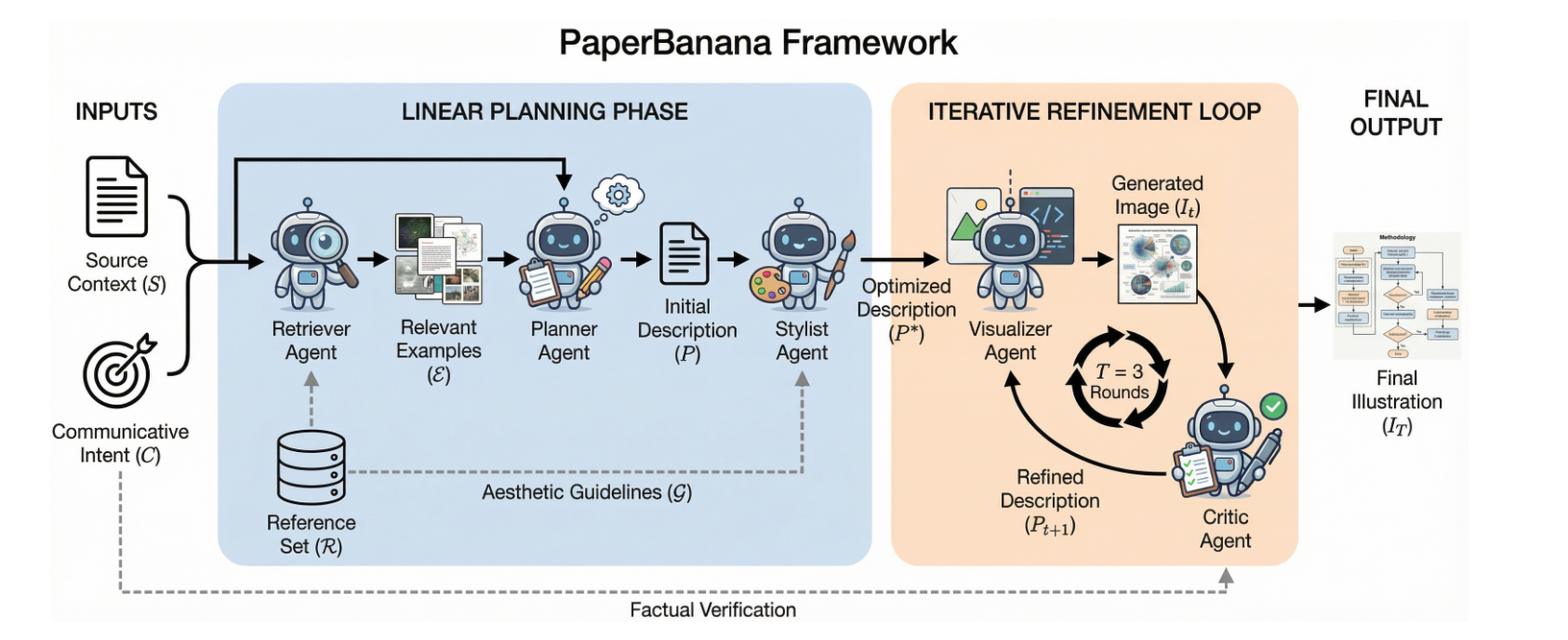
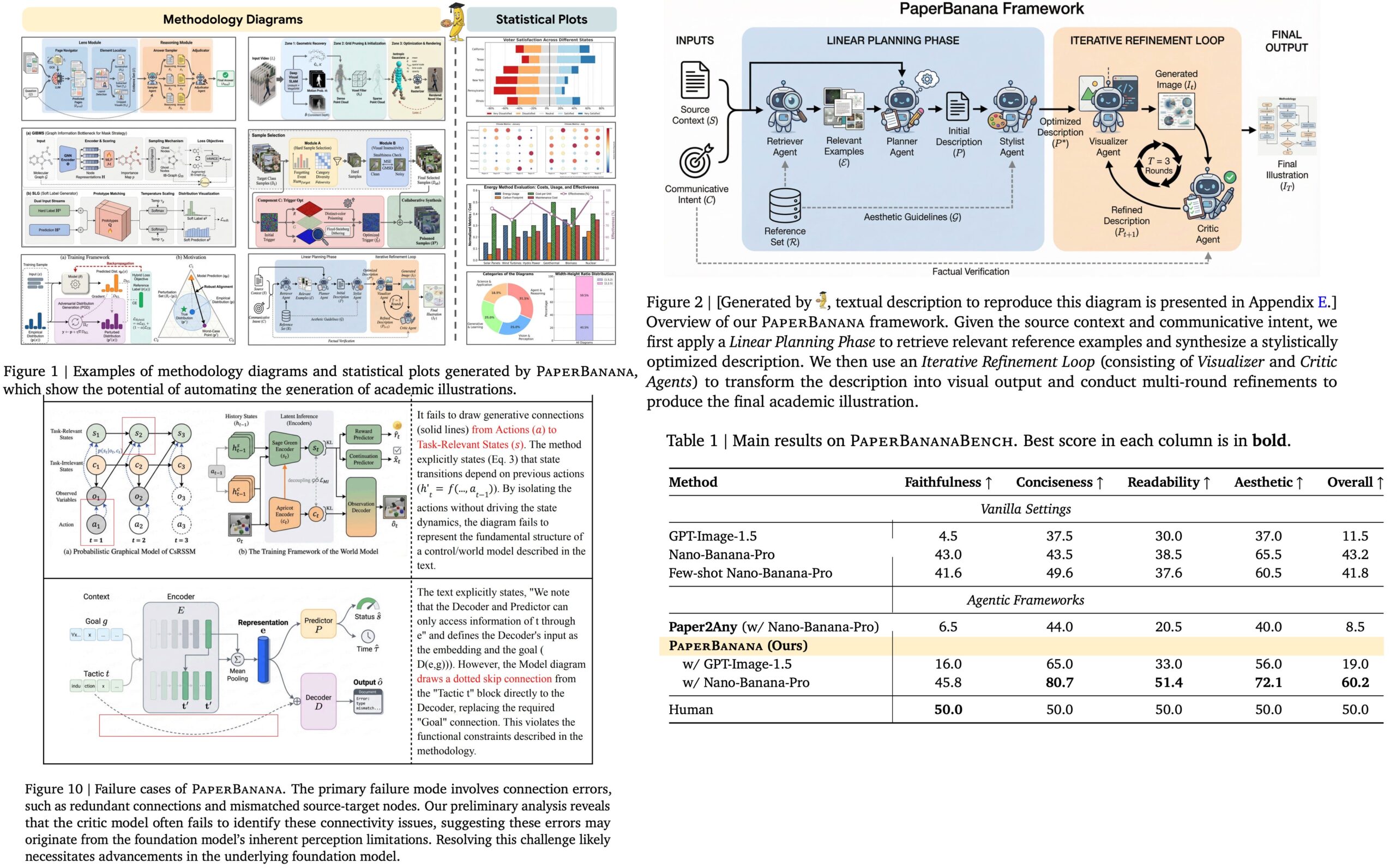
PaperBanana is an AI-powered research reasoning engine developed by Google AI. It goes beyond simple summarization tools and acts as a contextual, multi-document reasoning system.
Instead of just summarizing a single PDF, PaperBanana can:
-
Read multiple research papers simultaneously
-
Identify shared themes and contradictions
-
Extract methodologies and experimental results
-
Generate structured literature reviews
-
Create comparison tables automatically
-
Suggest future research directions
-
Answer complex research questions grounded in sources
In simple terms, PaperBanana functions like a research analyst that never gets tired.
Why the Name “PaperBanana”?
While the name may sound playful, it reflects a deeper concept. Google often uses internal codenames for projects that later become mainstream tools. “PaperBanana” symbolizes:
-
Peeling layers of complexity from academic papers
-
Extracting the core insights
-
Making dense knowledge more digestible
It’s about simplifying the research experience.
Core Capabilities of PaperBanana
1. Multi-Paper Understanding
Most AI tools process one document at a time. PaperBanana is designed to:
-
Compare 10–50 papers simultaneously
-
Detect overlapping experiments
-
Highlight performance benchmarks
-
Identify methodological differences
This drastically reduces time spent on literature reviews.
2. Citation-Aware Reasoning
One major issue with AI summarization tools is hallucination. PaperBanana addresses this through:
-
Source grounding
-
Explicit citation mapping
-
Confidence scoring
When answering a research question, it links responses directly to specific paragraphs or figures within papers.
3. Structured Literature Review Generation
Writing literature reviews is time-consuming. PaperBanana can generate:
-
Thematic literature reviews
-
Chronological research progress summaries
-
Gap analyses
-
Future direction recommendations
It formats results in academic-ready structures.
4. Cross-Domain Knowledge Linking
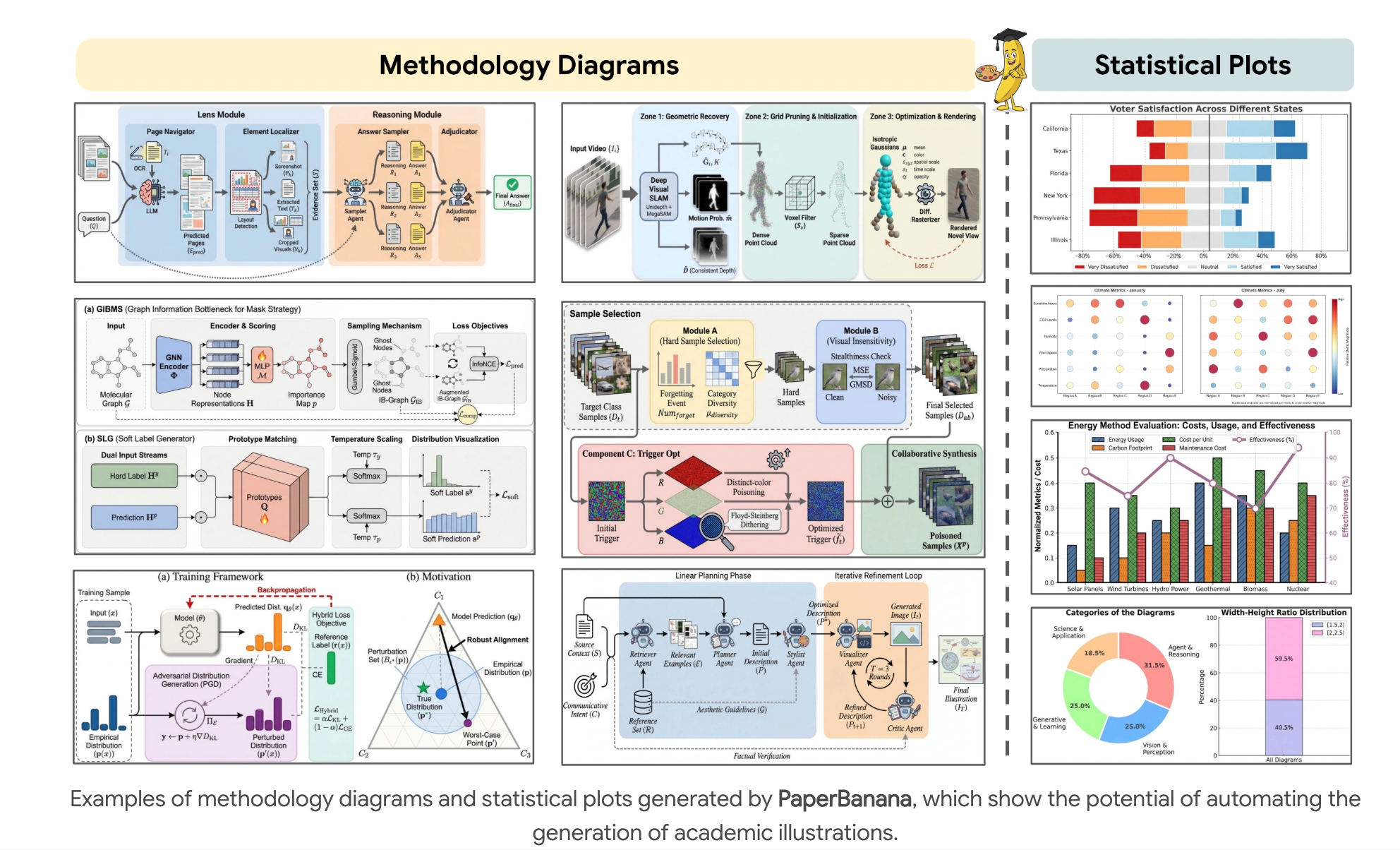
PaperBanana doesn’t treat papers as isolated units. It can connect research across domains.
For example:
-
Linking computer vision techniques to healthcare diagnostics
-
Connecting transformer architectures to robotics control systems
-
Mapping climate modeling research to AI-based simulation tools
This encourages interdisciplinary innovation.
5. Experimental Insight Extraction
Researchers often care about:
-
Dataset used
-
Model architecture
-
Baselines
-
Evaluation metrics
-
Performance improvements
PaperBanana extracts these into structured summaries or tables automatically.
How PaperBanana Works
Although Google hasn’t disclosed every technical detail, the system likely relies on:
Large Language Models (LLMs)
Advanced LLMs trained on:
-
Scientific text corpora
-
Peer-reviewed research
-
Mathematical reasoning datasets
Retrieval-Augmented Generation (RAG)
Instead of generating answers from memory, PaperBanana retrieves exact passages from documents before reasoning.
Graph-Based Knowledge Mapping
PaperBanana likely builds:
-
Citation graphs
-
Methodology graphs
-
Concept relationship maps
This helps it reason across documents rather than treating them independently.
Context Window Optimization
Processing dozens of long research papers requires efficient memory management. Google’s recent advances in extended context windows likely play a key role.
Real-World Use Cases
1. Academic Researchers
-
Faster literature review creation
-
Identifying research gaps
-
Comparing competing methods
-
Preparing survey papers
PhD students could save weeks of manual effort.
2. AI Startups
Startups constantly monitor new research. PaperBanana helps:
-
Track emerging trends
-
Benchmark against latest models
-
Identify open-source implementation ideas
-
Spot opportunities for product innovation
3. Corporate R&D Teams
Enterprises investing in AI or biotechnology can use PaperBanana to:
-
Analyze patent papers
-
Compare competitor research
-
Assess technical feasibility
-
Reduce time-to-market
4. Students and Educators
Students often struggle to understand dense research papers. PaperBanana can:
-
Simplify explanations
-
Break down equations
-
Explain experimental setups
-
Provide summary slides
This democratizes advanced knowledge.
How PaperBanana Differs From Other AI Research Tools
There are already AI tools that summarize PDFs. So what makes PaperBanana different?
| Feature | Traditional AI PDF Tools | PaperBanana |
|---|---|---|
| Single-document summary | Yes | Yes |
| Multi-paper reasoning | Limited | Advanced |
| Citation grounding | Basic | Strong |
| Gap analysis | No | Yes |
| Comparative tables | Rare | Built-in |
| Cross-domain linking | No | Yes |
The key difference lies in reasoning depth, not just summarization.
Impact on the Future of Research
When Google AI Introduces PaperBanana, it signals a larger shift:
AI is becoming a co-researcher.
We are moving from:
-
AI as a chatbot
to -
AI as a structured research collaborator
This could accelerate:
-
Scientific discovery
-
Drug development
-
Climate modeling
-
AI innovation
-
Policy research
Time saved on literature review can be reinvested into experimentation and creativity.
Ethical Considerations
While PaperBanana is powerful, it raises important questions.
1. Academic Integrity
If students rely too heavily on AI-generated literature reviews, originality may decline.
Institutions may need:
-
AI disclosure policies
-
Usage transparency guidelines
2. Bias in Research Selection
If PaperBanana prioritizes highly cited papers, niche but valuable research could be overlooked.
Balanced retrieval strategies are essential.
3. Over-Reliance on Automation
AI can summarize research, but true scientific intuition still belongs to humans.
PaperBanana should assist, not replace, critical thinking.
Potential Integration with Google Ecosystem
Given Google’s infrastructure, PaperBanana could integrate with:
-
Google Scholar
-
Google Drive
-
Google Docs
-
Vertex AI
-
Gemini models
Imagine:
-
Uploading 20 PDFs to Google Drive
-
Asking, “Summarize key transformer improvements since 2022”
-
Getting a structured research memo instantly
This would be revolutionary.
The Competitive Landscape
When Google AI introduces PaperBanana, competitors won’t stay silent.
Other tech giants and AI labs are building:
-
Research copilots
-
AI scientific assistants
-
Automated review tools
The race for AI-driven scientific automation is intensifying.
The Bigger Vision
PaperBanana represents more than a tool.
It represents:
-
AI as knowledge synthesizer
-
AI as interdisciplinary bridge
-
AI as research accelerator
If deployed responsibly, it could reduce friction in scientific progress.
Imagine a world where:
-
Researchers spend less time reading and more time discovering
-
Students understand cutting-edge AI without intimidation
-
Breakthroughs happen faster because knowledge is instantly accessible
That’s the promise behind Google AI Introduces PaperBanana.
Challenges Ahead
Despite the promise, challenges remain:
-
Handling mathematical precision
-
Understanding experimental nuance
-
Avoiding hallucination
-
Respecting copyright
-
Ensuring secure enterprise deployment
Scaling such a system globally will require continuous improvement.
Is PaperBanana the Future of Scientific Work?
The introduction of PaperBanana suggests we are entering a new era of:
Augmented research intelligence.
AI is no longer just answering questions — it’s helping humans generate better ones.
By automating:
-
Synthesis
-
Comparison
-
Structuring
-
Insight extraction
Google is redefining how research workflows operate.
Final Thoughts
When Google AI Introduces PaperBanana, it marks a milestone in intelligent research automation. In a world drowning in information, tools that extract structured insight are invaluable.
PaperBanana doesn’t eliminate the need for human expertise. Instead, it amplifies it.
Researchers still design experiments.
Scientists still interpret results.
Innovators still take risks.
But now, they may do it faster and with deeper contextual awareness.
The future of research isn’t just human or AI.
It’s collaborative intelligence.
And PaperBanana may be one of the clearest signals yet that this future is already unfolding
For quick updates, follow our whatsapp –https://whatsapp.com/channel/0029VbAabEC11ulGy0ZwRi3j
https://bitsofall.com/google-releases-conductor/
https://bitsofall.com/rare-disease-diagnosis-early-detection/
NVIDIA AI Release VibeTensor — What it is, why it matters, and what comes next
HackerNoon: How a Developer Blog Became a Global Tech Media Powerhouse