Domain-Specific AI: Tailored Intelligence for Targeted Needs
Artificial Intelligence has become a household term, but in the rush to embrace AI, one crucial fact often gets overlooked — not all AI is created equal. While general-purpose AI (like ChatGPT, Siri, or Google Gemini) aims to handle a wide variety of tasks, domain-specific AI is designed with a narrower focus, optimized for a specific industry, field, or use case.
This targeted approach enables deeper accuracy, better performance, and more meaningful results in specialized contexts. From healthcare diagnostics to financial fraud detection to agriculture yield prediction, domain-specific AI is quietly powering the systems we rely on every day.
In this article, we’ll explore what domain-specific AI is, why it matters, how it’s built, its benefits and challenges, and the future of this specialized intelligence.
What is Domain-Specific AI?
Domain-specific AI refers to artificial intelligence systems trained and optimized for a particular area of expertise or industry.
Instead of learning from vast, general data sets that cover a little bit of everything, domain-specific AI focuses on specialized data related to a single domain — for example:
-
Healthcare AI → Medical images, patient records, clinical trial results
-
Finance AI → Transaction logs, market trends, regulatory guidelines
-
Agriculture AI → Soil data, weather patterns, crop yield histories
-
Legal AI → Case laws, legal documents, court verdicts
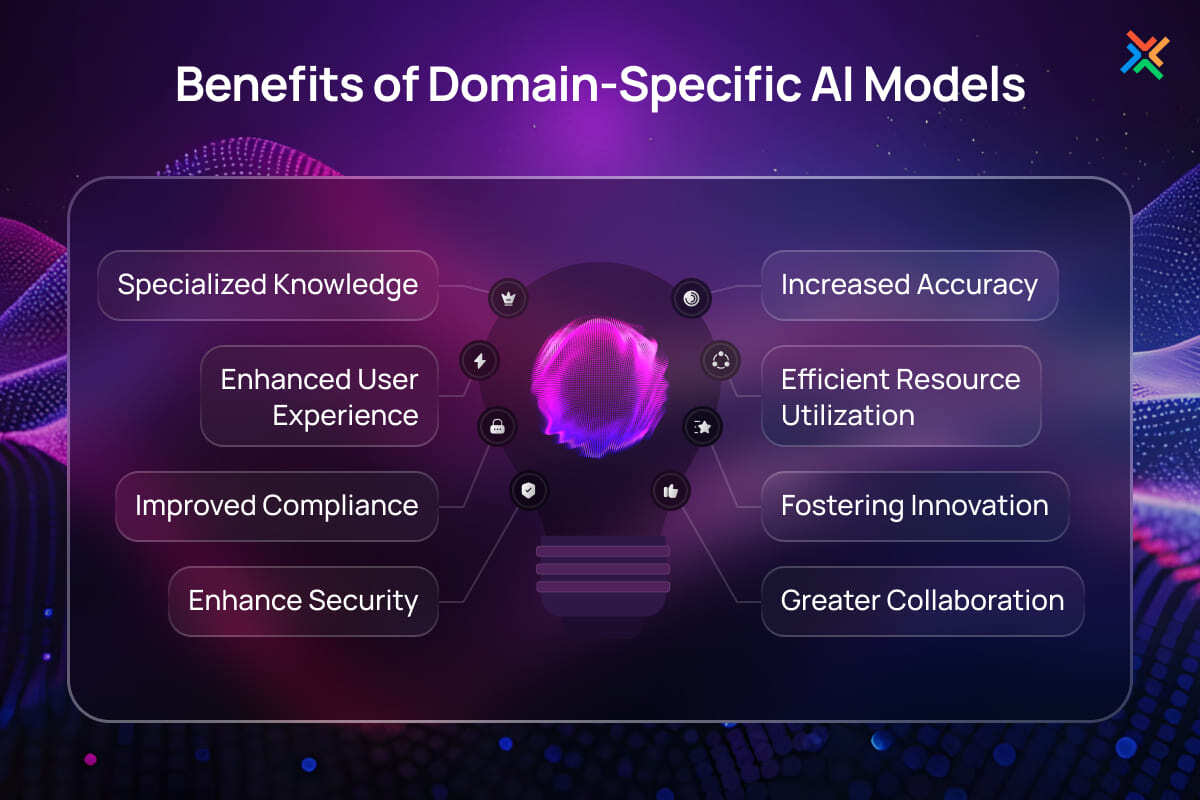
By training on highly relevant, domain-rich data, these AI systems gain deep contextual understanding that general-purpose AI often lacks.
Domain-Specific AI vs. General-Purpose AI
| Feature | General-Purpose AI | Domain-Specific AI |
|---|---|---|
| Scope | Broad, covers multiple domains | Narrow, focused on one domain |
| Training Data | Diverse, generic | Specialized, domain-rich |
| Accuracy | Good but may lack depth | High accuracy in targeted field |
| Examples | ChatGPT, Google Bard, Alexa | PathAI (medical), Kira Systems (legal) |
| Customization | Limited | Highly customizable |
Example:
If you ask a general-purpose AI about rare cardiac conditions, it might give a reasonable answer, but a domain-specific medical AI trained on millions of anonymized heart patient records can give a more precise, data-backed diagnosis suggestion.
How Domain-Specific AI Works
Creating a domain-specific AI system involves several steps:
1. Problem Definition
Clearly define the problem the AI needs to solve. For example, in finance, this could be detecting fraudulent credit card transactions in real time.
2. Data Collection
Gather domain-relevant data. For a legal AI, this could be millions of legal case documents, regulations, and judicial opinions.
3. Data Preprocessing
Clean and structure the data to ensure accuracy. This may involve removing duplicates, anonymizing sensitive information, or converting various file formats.
4. Model Selection & Training
Choose AI models that fit the problem type — for instance:
-
Computer Vision for medical image analysis
-
Natural Language Processing (NLP) for legal document review
-
Time-Series Models for stock market prediction
5. Domain Expert Involvement
Domain experts (doctors, lawyers, engineers) validate and guide AI development, ensuring the system’s outputs make sense in real-world contexts.
6. Testing & Evaluation
Models are tested against real scenarios to measure accuracy, reliability, and robustness.
Real-World Examples of Domain-Specific AI
1. Healthcare
-
IBM Watson Health: Helps oncologists by suggesting personalized cancer treatment plans.
-
PathAI: Improves diagnostic accuracy in pathology.
2. Finance
-
Kensho: Used by financial institutions for market forecasting.
-
Darktrace: AI for detecting cyber fraud and insider threats.
3. Agriculture
-
Prospera: Uses AI to analyze crop conditions and recommend farming practices.
-
Blue River Technology: Smart weeding systems that target individual plants.
4. Law
-
Kira Systems: Analyzes legal contracts and highlights key clauses.
-
ROSS Intelligence: AI legal research assistant.
5. Retail
-
Stitch Fix: AI-driven personalized clothing recommendations.
-
Granify: Predicts online shopper behavior to optimize conversions.
Benefits of Domain-Specific AI
-
Higher Accuracy
Tailored training leads to fewer mistakes and more precise outputs. -
Better Contextual Understanding
The AI understands industry-specific jargon, regulations, and workflows. -
Efficiency Gains
Automates repetitive specialized tasks, freeing up professionals for complex decision-making. -
Regulatory Compliance
Can be trained to adhere to domain-specific rules, such as HIPAA in healthcare or GDPR in data privacy. -
Competitive Advantage
Companies with well-implemented domain-specific AI can outperform rivals using generic solutions.
Challenges in Developing Domain-Specific AI
-
Data Scarcity
Specialized domains may not have large, clean, and labeled datasets. -
High Development Costs
Requires domain experts, specialized infrastructure, and ongoing maintenance. -
Bias & Ethical Risks
Limited datasets can cause bias, leading to unfair or inaccurate results. -
Scalability Issues
AI trained for one domain may not easily adapt to another. -
Regulatory Hurdles
Some industries, like healthcare and finance, have strict compliance requirements.
The Future of Domain-Specific AI
The next decade will likely see an explosion of domain-specific AI solutions. Some key trends include:
-
AI-as-a-Service for specific industries: Pre-built models for healthcare, law, agriculture, etc.
-
Integration with IoT devices: AI in manufacturing, supply chains, and smart farming.
-
Cross-domain hybrid models: AI combining expertise from multiple domains for complex problems.
-
Personalized AI assistants: Custom AI for individual professionals like doctors, lawyers, and researchers.
Example: Imagine a “Personal AI Surgeon Assistant” that not only assists during surgery but also provides patient-specific recommendations post-operation.
Final Thoughts
Domain-specific AI is not about replacing general-purpose AI — it’s about complementing it. While general AI provides versatility, domain-specific AI delivers depth, precision, and actionable intelligence for highly specialized needs.
In the coming years, businesses and governments will increasingly rely on such tailored AI systems to gain a competitive edge, ensure regulatory compliance, and deliver better services.
If general AI is like a Swiss Army knife, domain-specific AI is the surgical scalpel — designed for one purpose, and extremely effective at it.
https://bitsofall.com/https-yourwebsite-com-top-5-ai-powered-fitness-trackers-2025/
Democratization of AI: How Artificial Intelligence is Becoming Accessible to All