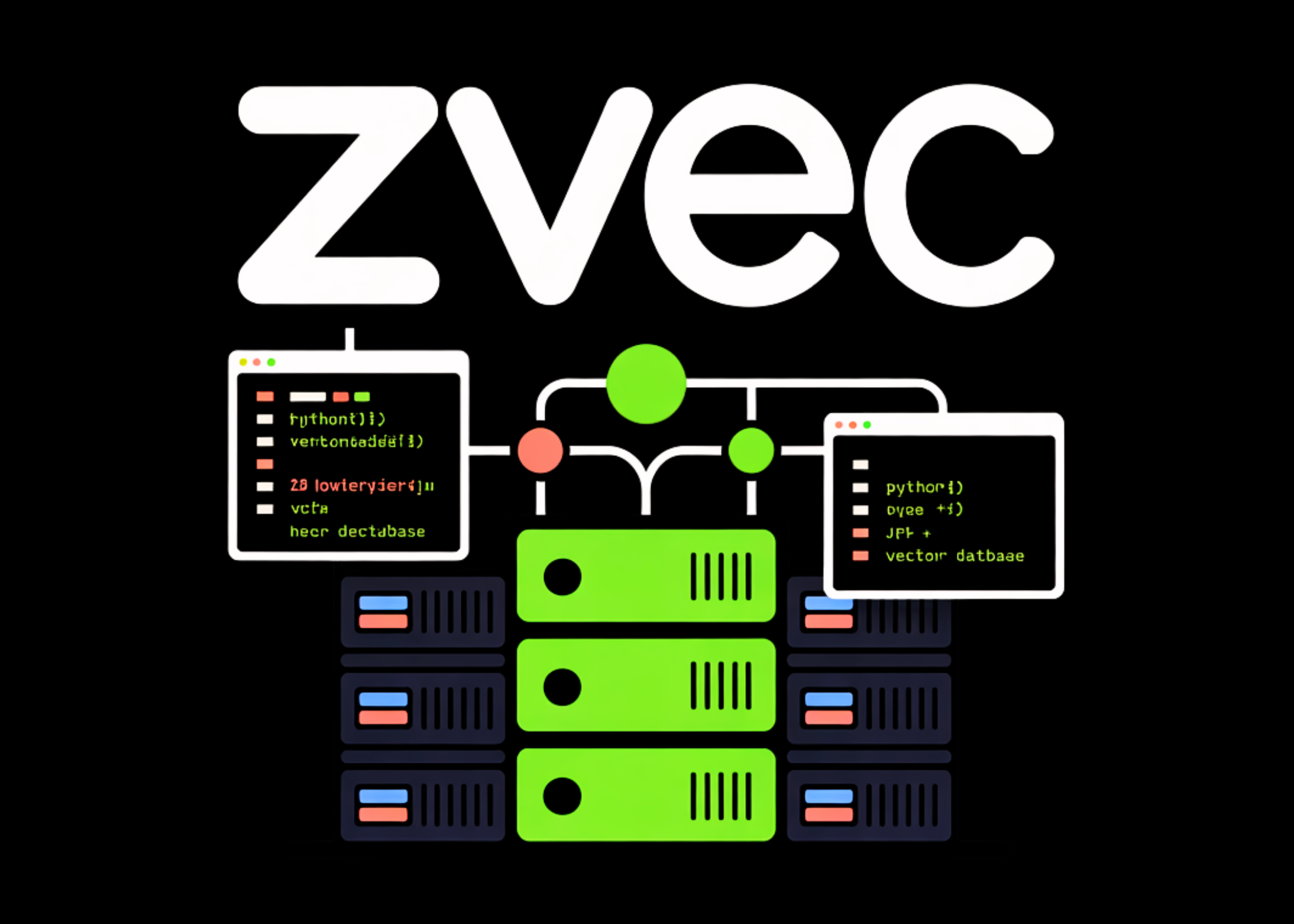
Alibaba Open-Sources Zvec — A Lightweight, In-Process Vector Database Built for Speed and Edge Deployments
Executive summary (TL;DR)
Alibaba Open-Sources Zvec — a compact, zero-dependency, in-process vector database designed to be embedded directly into applications for low-latency similarity search. Zvec builds on Alibaba’s battle-tested Proxima search tech and targets scenarios where external vector backends are too heavy or network calls are too slow: local caching, edge devices, mobile apps, desktop clients, and microservices that require millisecond lookups. The repo and initial releases provide docs, benchmarks, and quickstarts for C/C++ and bindings.
Why this matters: the problem Zvec solves
Vector databases have become essential infrastructure for retrieval-augmented generation (RAG), semantic search, recommendation systems, and many AI applications that rely on dense embeddings. But most popular vector stores are run as separate services (hosted clusters, managed cloud services, or local daemons). That architecture introduces:
-
Network latency for every lookup (bad for low-latency apps).
-
Operational overhead to deploy and maintain a separate service.
-
Resource inefficiency on edge or embedded devices.
Alibaba Open-Sources Zvec addresses these gaps by providing an in-process store — meaning the vector index runs in the same process as your application, with no external server required. This design reduces round-trip time, simplifies deployment, and enables embedding vector search directly into environments where running a separate service is impractical.
What is Zvec? (features at a glance)
From the repository and release notes, Zvec’s core selling points are:
-
In-process embedding: zero dependency, runs inside your process, no network hop.
-
Built on Proxima: uses Alibaba’s Proxima technology as a foundation for efficient similarity search.
-
Lightweight & low latency: optimized for millisecond lookups and minimal memory overhead.
-
Cross-platform builds: designed to compile into small binaries for varied runtimes (edge, desktop, serverless containers).
-
Simple API + quickstart: documentation and examples to get started quickly; intended for developers who want to embed vector search without heavy infra.
These features make Zvec attractive where speed, simplicity, and deployability matter more than massive distributed scale.
Technical design (how Zvec works)
Zvec follows an embedded/index-library pattern rather than a client-server database model. The README and code show these architectural choices:
-
Indexing formats and algorithms — Zvec implements compact similarity index formats (approximate nearest neighbor structures) that are tuned for in-memory performance and efficient disk persistence. The implementation inherits optimizations from Proxima to balance throughput and recall.
-
Zero-dependency build — Zvec emphasizes minimal external requirements so it can be statically linked into applications or shipped as a small dynamic library, making cross-compilation and edge packaging straightforward.
-
Persistence & snapshots — the project includes ways to persist indices to disk and quickly reload them, enabling cold start speed for embedded devices. (See repo docs for exact APIs.)
-
Language bindings — while the core is implemented for maximal performance, the repo provides bindings or examples to call Zvec from higher-level languages used in AI stacks. Check the repository for the current set of bindings and community contributions.
Benchmarks & performance claims
Alibaba published initial benchmarks with the repo and release notes showing microbenchmarks and latency figures for typical similarity search tasks. The release history indicates early tags and performance tuning since the January 2026 launch. As with any benchmark, results depend on dataset, dimensionality, hardware, and configuration — so run realistic tests matching your workload.
Practical takeaway: Expect significantly lower lookup latency compared to remote vector services (no network), and better cold-start performance when indices are persisted locally.
When to use Zvec (best fit)
Choose Zvec when your use case matches one or more of the following patterns:
-
Edge or on-device inference: mobile apps, IoT gateways, offline desktop tools where a local index improves UX.
-
Microservices requiring ultra low latency: services that cannot tolerate RPC round trips to a vector cluster.
-
Testing and development: quick local prototyping without provisioning external infrastructure.
-
Hybrid architectures: combine local Zvec instances for hot data and a central vector cluster for cold or large-scale storage.
-
Cost-sensitive deployments: avoid the operational cost of dedicated vector clusters for smaller datasets.
If you need global scale for billions of vectors with complex replication and multi-tenant features, you may still prefer a dedicated, distributed vector store; Zvec’s win is latency and simplicity.
Example integration patterns
-
Desktop semantic search app
Embed Zvec binary into the app to perform local similarity lookup over user data (notes, documents) without sending sensitive content to the cloud. -
API gateway cache
Use Zvec as a hot cache inside an API service: keep the most frequently accessed embeddings in Zvec and fall back to a remote store for less common queries. -
Edge recommendation engine
Deploy Zvec on gateway hardware to produce sub-100ms recommendations for users in locations with spotty connectivity. -
Hybrid RAG (Retrieval Augmented Generation)
Use Zvec for immediate context retrieval from a user’s local files for privacy-sensitive prompts, while the central model still calls a cloud LLM for heavy reasoning.
For code snippets and specific APIs, consult the official alibaba/zvec repository quickstart and examples.
Migration & adoption checklist
If you plan to adopt Alibaba Open-Sources Zvec, follow these steps:
-
Evaluate dataset size and dimensionality — benchmark with your embeddings (e.g., 768 vs 2,048 dims).
-
Test recall/precision tradeoffs — tune index parameters to balance accuracy and latency.
-
Plan persistence — configure snapshot and disk persistence to meet startup time SLAs.
-
Security & privacy — if running on user devices, ensure secure storage and access controls for persisted indices.
-
CI/CD & packaging — integrate Zvec builds into your build pipeline (static linking/cross-compile for target platforms).
-
Monitoring — add telemetry for query latency and index sizes when embedded in production services.
Repository docs contain practical commands and examples to get started.
Licensing & community
Zvec is published on GitHub and distributed under an open-source license included in the repository. Review the LICENSE file in the repo to confirm compatibility with your product or company policies before embedding it into commercial products. Community engagement (issues, PRs, Discord/X links) is available in the repo README to help you get support or contribute.
Limitations & tradeoffs
No technology is a silver bullet. Consider these tradeoffs:
-
Single-process scope: Zvec is optimized for embedded and local usage — if your product requires large, distributed indices with global consistency guarantees, a cluster-based solution may be more appropriate.
-
Memory limits: running large indices in process consumes RAM; for very large corpora, offload cold data.
-
Operational model: embedding simplifies deployment but moves responsibility for updates, backups, and scaling to the application team.
-
Ecosystem maturity: Zvec is new — integrations, client SDKs, and community plugins will grow over time. Check the repo and community channels for up-to-date support.
Real-world use cases (illustrative)
-
Privacy-first note apps — local semantic search across encrypted notes without cloud exposure.
-
Offline customer support tools — on-premise retrieval of product manuals for technicians in the field.
-
Gaming — fast local similarity search for content personalization or matchmaking heuristics.
-
AR/VR applications — low-latency semantic lookup for scene understanding on headsets.
These examples highlight where embedding the index into the application process improves UX and privacy.
How to get started (quickstart)
-
Clone the repo:
git clone https://github.com/alibaba/zvec.gitand inspect README and examples. -
Build: follow the repo’s build instructions for your target platform (look for
quickstartorbuildsections). -
Index sample data: use provided scripts to index synthetic or sample embeddings and run queries.
-
Benchmark: run the included benchmark suite to tune parameters for your workload.
For exact commands and code examples, consult the repository’s README and the docs/ folder.
Community & where to follow updates
The project lives on GitHub where releases and issues are tracked; initial releases appeared in late January 2026 with follow-up updates. For announcements, check the repository’s release page and Alibaba/Tongyi Lab social posts. Contributing via issues and pull requests is the standard path for improvements and features.
Final thoughts: who should watch Zvec
Alibaba Open-Sources Zvec is an important addition to the vector-database landscape because it fills a clear niche — in-process, zero-dependency vector search. Organizations building privacy-sensitive, latency-critical, or edge-deployed AI products should evaluate Zvec as a likely fit. It won’t replace distributed vector clusters for every workload, but it gives developers another powerful tool to reduce complexity and latency in modern AI stacks.
Quick reference (top citations)
-
Official GitHub repo (README & repo):
alibaba/zvec. -
Releases (v0.1.1 and tags): release notes and timestamps (Jan 27, 2026).
-
README blob/quickstart snapshot.
-
Announcement/short posts and social mentions (Tongyi Lab / X posts).
For quick updates, follow our whatsapp –https://whatsapp.com/channel/0029VbAabEC11ulGy0ZwRi3j
https://bitsofall.com/rare-disease-diagnosis-early-detection/
https://bitsofall.com/nvidia-ai-vibetensor/
HackerNoon: How a Developer Blog Became a Global Tech Media Powerhouse
Google AI Introduces PaperBanana: A Breakthrough in Intelligent Research Automation