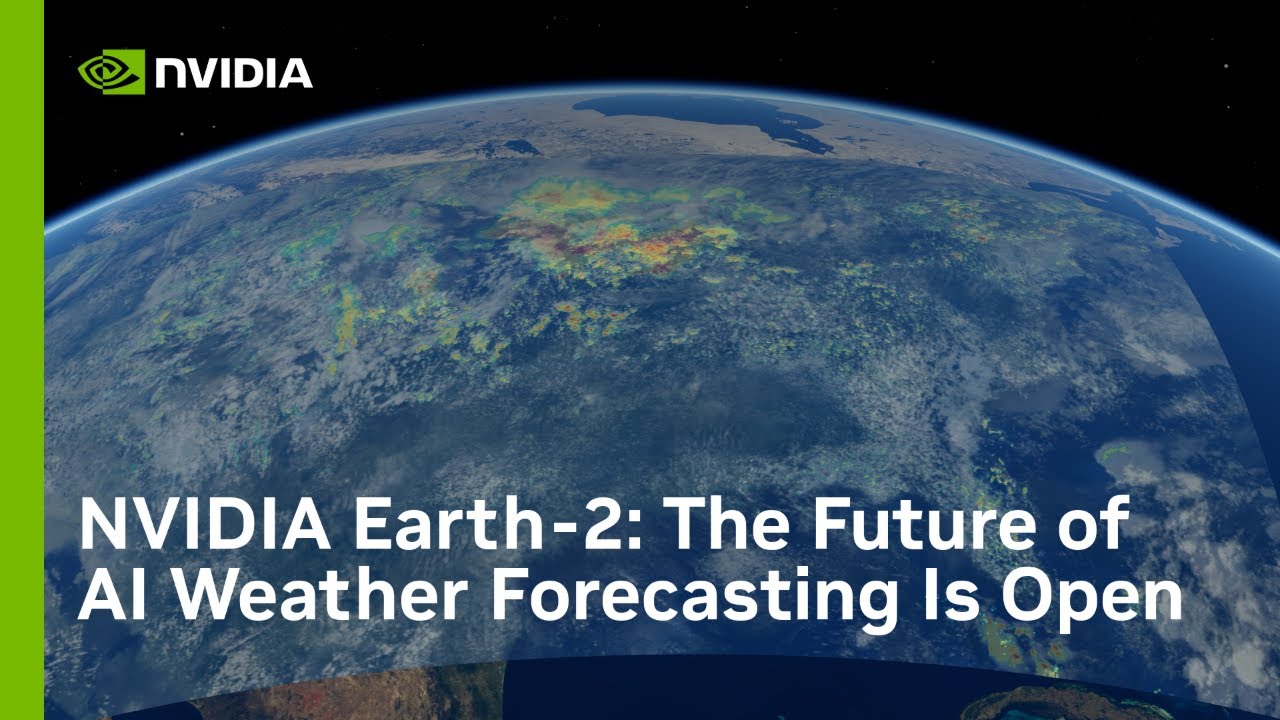
NVIDIA Revolutionizes Climate Tech with ‘Earth-2’
Meta description: NVIDIA’s Earth-2 is a new, open family of AI models, tools, and visualization technology that aims to transform weather and climate forecasting — making high-resolution, energy-efficient, and faster forecasts accessible to scientists, governments, insurers, and cities worldwide.
When Jensen Huang said that AI would change every industry, climate and weather forecasting were always near the top of the list. With the launch of Earth-2, NVIDIA has taken a giant step from promise to product: a coordinated family of open AI models, data-assimilation tools, and visualization services designed to accelerate how we simulate, predict, and visualize Earth’s atmosphere — at scales that were once the exclusive domain of national supercomputing centers. Earth-2 is ambitious: it aims not only to speed forecasts, but to democratize high-resolution, probabilistic climate and weather intelligence for disaster preparedness, energy planning, insurance risk modelling, and urban resilience.
What is Earth-2? A short primer
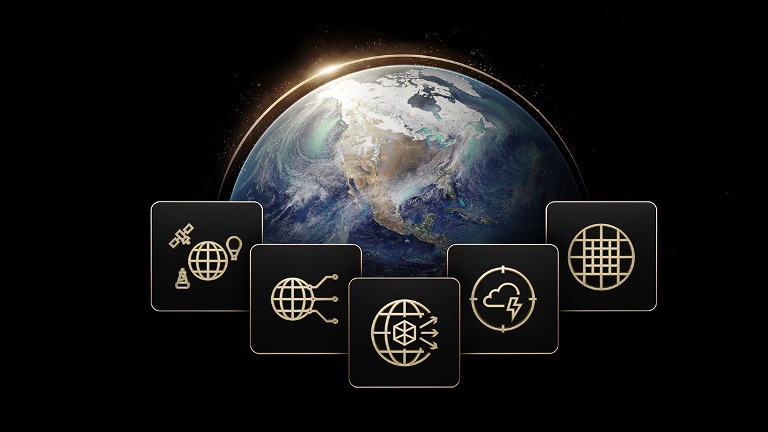
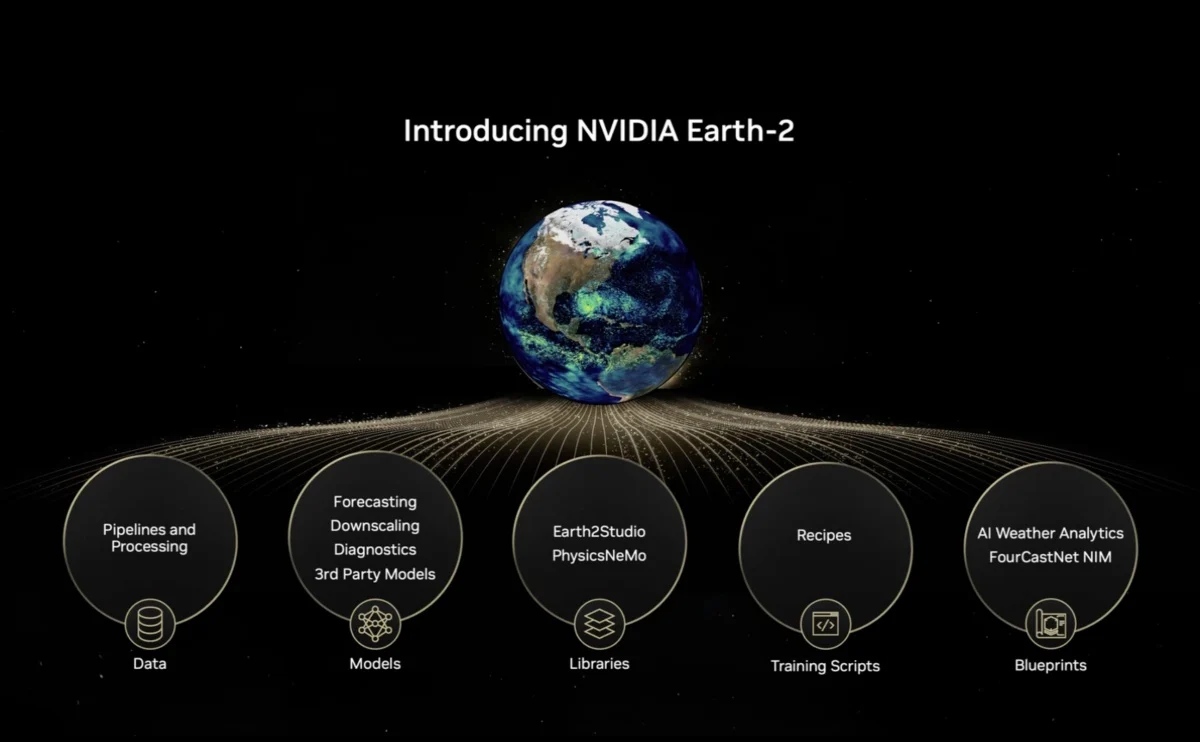
Earth-2 is a suite of open models, APIs, and developer tools from NVIDIA that together create an “AI weather” platform. Rather than being a single model, Earth-2 is a family — with components that handle different parts of the weather-forecasting pipeline:
-
Global data assimilation to ingest and turn raw observations (satellites, radars, sensor networks) into coherent initial atmospheric states rapidly.
-
Medium-range and short-term forecasting models that produce global 15-day forecasts and high-resolution local storm nowcasts.
-
Downscaling and generative models that translate coarse model outputs into kilometer- and street-level predictions suitable for city planners and first responders.
-
Visualization and digital-twin tools built on the NVIDIA Omniverse to explore data interactively in 3D.
Crucially, NVIDIA is positioning Earth-2 as open source — releasing models, notebooks, and deployment tooling on GitHub and Hugging Face so researchers, startups, national weather services, and insurers can build on the same base code and models. That openness is a strategic pivot: it encourages rapid adoption and community-driven improvement while lowering barriers for nations and organizations with limited supercomputing budgets.
Why this is a potential game changer
Traditional weather forecasting relies heavily on numerical weather prediction (NWP): physics-based models that solve fluid dynamics and thermodynamics on a discretized grid. These models are robust and grounded in first principles, but they are computationally expensive. Running large ensembles (the standard method to quantify forecast uncertainty) requires huge compute, and finer spatial resolution drastically increases cost. That’s the problem Earth-2 aims to solve.
NVIDIA’s approach replaces or augments parts of the NWP pipeline with AI models that can be trained once and then executed orders of magnitude faster on GPUs. The company claims dramatic speedups and energy improvements: trained Earth-2 models can run many hundreds to thousands of times faster than traditional simulations for certain tasks, enabling huge ensemble sizes, near-real-time re-runs, and routine kilometer-scale forecasting that would otherwise be prohibitively expensive. The implications are obvious — more ensembles mean better probabilistic forecasts; faster runs mean timelier warnings for storms, floods, and heat waves; cheaper runs mean broader access.
The core components (what’s in the family)
While the Earth-2 family is broad, a few standouts illustrate its technical strategy:
-
Earth-2 Global Data Assimilation (HealDA / Earth-2 Global Data Assimilation): Data assimilation traditionally takes hours on large clusters. Earth-2’s assimilation promises to create initial conditions in seconds on GPUs, enabling much quicker forecast cycles and the ability to run many more ensemble members. This is a keystone: better initial conditions feed better forecasts.
-
FourCastNet 3 and Atlas (or Atlas-style architectures): Evolution of prior AI forecasting architectures (like FourCastNet) designed for rapid global forecasting that maintain or improve on accuracy while being far more efficient than standard NWP. These models can be trained on larger datasets and capture complex spatial patterns at scale.
-
CorrDiff (generative downscaling): A generative module that performs high-resolution downscaling far faster and more efficiently than physical downscaling. CorrDiff enables translation of coarse global forecasts into city- and street-level fields (precipitation, wind, temperature) useful for urban planners and emergency services. NVIDIA claims orders of magnitude speed and energy improvements here.
-
StormScope / short-term storm models: Specialized models trained on satellite and radar imagery to predict severe-convective events on short windows (hours ahead), improving lead time for flash floods, hail, and tornado warnings.
Each of these building blocks maps onto a common goal: swap expensive, slow numerical steps for GPU-friendly learned components, but keep the scientific rigor and uncertainty quantification that operational forecasting needs.
Who is using Earth-2 today?
NVIDIA’s announcement and subsequent reporting show an early but diverse ecosystem adopting Earth-2 tools: national weather services (e.g., Taiwan’s Central Weather Administration), private data firms (Spire, The Weather Company), insurers and risk-modelers, energy companies, and academic partners (Berkeley Lab, Barcelona Supercomputing Center). Early adopters emphasize two motivations: the ability to run larger ensembles affordably, and the capacity to generate hyperlocal forecasts that are actionable for cities and infrastructure.
Investors and customers are already taking notice. News outlets and industry reports show partnerships and pilots where Earth-2 augments or accelerates existing forecasting pipelines, and companies in energy and insurance are exploring how Earth-2’s speed and resolution can improve decisioning (e.g., grid load forecasts, catastrophe risk pricing).
Accuracy, verification, and scientific rigor
Any claim of “faster and cheaper” must be balanced by accuracy and reliability. NVIDIA has emphasized that Earth-2 is not about replacing physical models entirely but about producing forecasts that — when paired with sound verification — match or exceed traditional model skill at much lower compute cost. The company highlights internal benchmarks and collaborations with academic partners to evaluate model skill across dozens of weather variables, and early independent reporting suggests promising results in several test cases. Still, broad operational adoption requires extensive, independent verification across climates and event types.
Crucially, open sourcing the models helps scientific reproducibility: researchers can inspect, test, and improve the models on diverse datasets. That transparency is one reason many meteorological organizations have engaged with Earth-2 — the openness lowers the barrier to scientific evaluation and fast iteration.
Applications: where Earth-2 could make the biggest difference
-
Disaster preparedness and response: Faster runs and denser ensembles can produce earlier, more confident warnings for hurricanes, convective storms, and floods. Downscaled outputs can provide neighborhood-level flood inundation maps and wind-damage estimates.
-
Insurance and catastrophe modelling: Insurers can run massive ensembles to quantify tail risks (very rare, very severe events) more cost-effectively. That improves pricing, capital allocation, and reinsurer negotiations.
-
Energy grid planning and renewables integration: Wind and solar forecasting benefit from finer spatial and temporal resolution; better forecasts reduce balancing costs and make renewable sources more dispatchable.
-
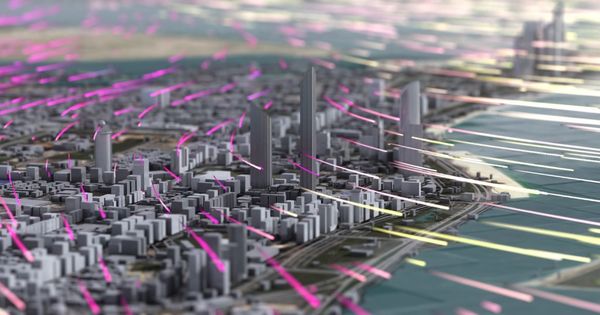
Urban planning and climate resilience: City planners can use street-level forecasts for heat island mapping, drainage planning, and transport disruption modelling, integrating Earth-2 outputs into digital twins built on Omniverse.
-
Environmental science and research: Faster simulations enable more extensive scenario studies for climate attribution, extreme event analysis, and process understanding. Academia can iterate experiments that were previously too costly.
Limitations and open questions
Earth-2 is powerful, but it’s not a silver bullet. A few important caveats:
-
Generalization and regime shifts: AI models learn from historical data. When confronted with novel regimes (new climate states, sensors, or extreme rare events), they may underperform unless retrained or adapted carefully. Operationalizing Earth-2 will require robust strategies for model adaptation and continual training.
-
Data quality and assimilation: Fast data assimilation is only as good as the input streams. In regions with sparse observations, data gaps will limit accuracy; part of Earth-2’s promise is better use of satellite and unconventional data sources, but ground truth remains crucial.
-
Governance, transparency, and liability: When faster, AI-driven forecasts start influencing evacuation orders, insurance payouts, or grid actions, governance questions arise: who is responsible if an AI forecast misses? Open sourcing helps transparency, but operational responsibility will still require clear institutional frameworks.
-
Compute and carbon tradeoffs: While Earth-2 claims large energy efficiency gains for inference, training large AI models is still compute-intensive. The net climate footprint depends on training frequency, model updates, and whether GPU use displaces even larger HPC workloads. Organizations must account for these tradeoffs when deploying Earth-2 at scale.
The broader landscape: who else is in the race?
NVIDIA is not alone. Large cloud vendors and research labs have been experimenting with AI forecasting for years, and startups are building niche products for storm nowcasting, flood mapping, and microclimate prediction. What differentiates Earth-2 is the integrated stack (assimilation, forecasting, downscaling, visualization) and NVIDIA’s strategic combination of open-source releases with commercial Omniverse and Cloud API offerings. This dual approach — open models plus enterprise tooling — could accelerate industry adoption faster than pure research releases.
What success looks like
We’ll know Earth-2 is succeeding when we see:
-
Operational adoption at national weather services for routine forecasting or as an augmentation to NWP.
-
Commercial scaling where insurers, utilities, and cities deploy Earth-2–based forecasts in production decision loops.
-
Peer-reviewed verification showing sustained or improved forecast skill across multiple climates and variables.
-
Community contributions improving model robustness, especially from research groups in underrepresented regions.
Each of these milestones addresses a different dimension: operational trust, commercial value, scientific validity, and global inclusivity.
A practical example: storm forecasting and a city digital twin
Imagine a coastal city with a critical power substation network. Traditionally, emergency planners consult regional NWP outputs and probabilistic storm tracks from national centers, then translate those into localized risk maps. With Earth-2, the workflow could change: rapid data assimilation provides near-real-time initial conditions; StormScope forecasts give high-confidence short-term convective activity; CorrDiff downscaling translates that into street-level rainfall and wind maps; and Omniverse visualization overlays the forecast on a city digital twin, letting utilities run automated contingency plans — all within a timescale that lets them pre-position crews and issue targeted advisories. That’s the practical value proposition Earth-2 sells.
Conclusion: a pragmatic revolution
Earth-2 is not merely about building a better model; it’s about reshaping the whole forecasting ecosystem. By combining open models, fast data assimilation, generative downscaling, and immersive visualization, NVIDIA is offering a practical pathway for organizations to make weather and climate intelligence more actionable and equitable. The technology won’t erase the need for physics or expertise — successful deployment will still require meteorologists, modelers, and domain experts — but it can dramatically expand the speed, resolution, and access to forecasts that matter for human lives and infrastructure.
If Earth-2 delivers on its promises — faster, cheaper, and verifiably accurate forecasts at operational scales — it could be one of the most consequential climate-tech advances of the decade. For now, the community’s next steps are clear: independent verification, inclusive deployment (especially for data-poor regions), and careful governance so that this powerful tool serves resilience and justice as much as efficiency and profit.
For quick updates, follow our whatsapp –https://whatsapp.com/channel/0029VbAabEC11ulGy0ZwRi3j
https://bitsofall.com/microsoft-releases-vibevoice-asr-deep-dive/
https://bitsofall.com/apple-siri-overhaul-ai-chatbot/
What Is Clawdbot? A Deep Dive Into the AI-Powered Robotic Worker
How an AI Agent Chooses What to Do Under Tokens, Latency, and Tool-Call Budget Constraints