
Meet SETA: Open-Source RL Training Environments for Terminal Agents (400 Tasks) + CAMEL Toolkit
Terminal agents are quickly becoming one of the most practical forms of “agentic AI” in the real world: they can compile projects, fix broken dependencies, run security scans, manipulate files, manage Git workflows, and automate DevOps-like tasks—exactly the things developers do daily. But training these agents has been messy.
Most teams rely on prompt engineering, brittle tool-calling demos, or small, hand-crafted task sets. The hard part isn’t just executing commands—it’s learning robust, end-to-end behavior: planning, correcting mistakes, handling partial failures, and still reaching a verifiable outcome inside a real shell environment.
That’s the gap SETA is designed to close.
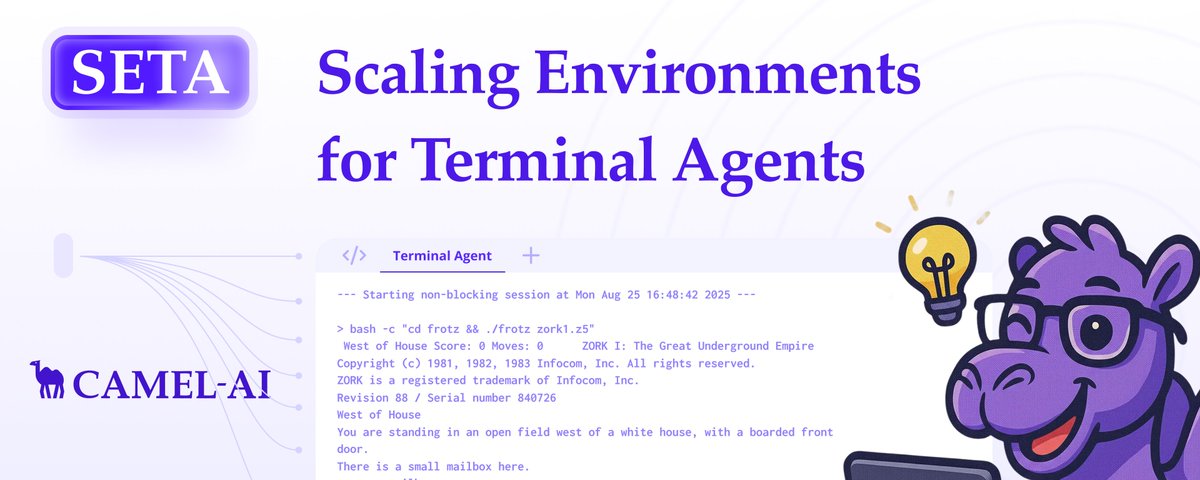
SETA (Scaling Environments for Terminal Agents) is an open-source project that combines:
-
A reproducible agent toolkit stack for terminal-based agents (built around CAMEL),
-
A scalable synthetic environment + task generation pipeline, and
-
A large RL-ready dataset of 400 containerized terminal tasks aligned with the Terminal-Bench format.
In this article, we’ll unpack what SETA is, why it matters, how its dataset is structured, what “benchmark-aligned RL training” really means for terminal agents, and how you can use it to build stronger command-line agents without reinventing the whole training stack.
Why terminal agents are hard to train (and why it matters)
A terminal environment is deceptively simple: it’s text in, text out. But real terminal tasks are multi-step, stateful, and unforgiving:
-
You need to navigate directories and understand context.
-
Commands can fail for countless reasons (missing packages, permission issues, wrong flags).
-
Solutions often require iteration: check logs → change config → rerun tests.
-
The only thing that truly matters is verifiable success (did the build pass? did the test suite pass? did you remove the secret keys?).
This is why evaluation suites like Terminal-Bench exist: to test agent performance on real, end-to-end terminal tasks inside containers—scored by objective checks, not “looks good to me” outputs.
But evaluation is only half the story. If you want better agents, you need better training environments—and this is where most teams hit a wall:
-
Collecting tasks is expensive.
-
Designing reward signals is tricky.
-
Ensuring tasks are reproducible and verifiable is time-consuming.
-
Scaling task variety without breaking quality is hard.
SETA’s core pitch is: open-source the full stack—tooling + environments + verifiable tasks—so researchers and builders can train terminal agents with RL in a standardized, benchmark-aligned way.
What exactly is SETA?
SETA is presented as a community project focusing on reinforcement learning for terminal agents—agents operating in Unix-style shells under an evaluation harness like Terminal-Bench.
At a high level, SETA includes:
1) The SETA agent codebase (toolkits + evaluation + training)
The main repository provides the framework to:
-
run agents on tasks one-by-one,
-
run official Terminal-Bench evaluations,
-
train terminal agents using RL workflows (in the
training/area).
2) The SETA environments / RL dataset (400 tasks)
SETA also ships an environment dataset where each task is packaged as:
-
task.yaml(instruction + metadata), -
Dockerfile(containerized environment), -
run-tests.sh(verifiable evaluation script).
That structure matters because it makes tasks:
-
reproducible (containers),
-
automatically scorable (tests),
-
compatible with existing eval harnesses (Terminal-Bench task format).
3) Alignment with Terminal-Bench
SETA is explicitly benchmark-aligned: tasks are compatible with Terminal-Bench format, and the repo includes scripts for running Terminal-Bench evaluations.
This alignment is important because it reduces the classic RL problem of “training on one thing and evaluating on another.” If your training tasks look nothing like the benchmark tasks, gains don’t transfer. SETA is built to make transfer more likely.
The 400-task dataset: what’s inside and why it’s useful
The SETA dataset is described as a synthetic RL dataset containing 400 terminal tasks, with continuous scaling and a subset used for RL fine-tuning.
A notable detail from the project report: 260 of the 400 tasks were used for RLVR fine-tuning of a Qwen3-8B based model.
Why containerized tasks are the “secret sauce”
If you’ve ever tried to build an RL dataset for system tasks, you know the nightmare:
-
One machine has
gcc, another doesn’t. -
Package mirrors differ.
-
A dependency update breaks the task.
-
The “correct” output changes over time.
By packaging each task with a Dockerfile and tests, SETA makes tasks portable and stable, which is essential for RL loops where you need to run tasks repeatedly at scale.
What kinds of tasks do terminal agents need?
Terminal-Bench 2.0 is commonly described as covering 89 tasks across diverse domains (software engineering, security, biology, gaming, etc.), executed in containers with objective scoring.
SETA’s synthetic dataset aims to build the foundation skills that help an agent succeed on these kinds of tasks: shell navigation, tooling, Git workflows, environment setup, debugging, and more—while still using verifiable checks.
CAMEL Toolkit: why SETA leans on structured toolkits (not raw “run command” calls)
A big reason terminal agents fail isn’t that the base model can’t “write a command.” They fail because the agent has:
-
poor state tracking,
-
inconsistent logging,
-
weak safety boundaries,
-
no stable interface for tool execution and result retrieval.
SETA’s approach integrates structured toolkits—especially a TerminalToolkit from CAMEL that provides terminal operations, session management, and safety boundaries (like restricting execution/writes to a working directory).
From the CAMEL documentation, TerminalToolkit includes capabilities like executing shell commands, managing sessions, and enforcing working-directory restrictions (safe-mode behaviors).
This matters for RL training because your environment loop needs:
-
consistent action interfaces (tools),
-
consistent observation formatting (outputs/logs),
-
consistent constraints (so the agent doesn’t go “off rails” during exploration).
Benchmark performance claims (what SETA reports)
SETA-related materials describe strong Terminal-Bench performance when using frontier base models inside the agent harness.
For example, MarkTechPost’s write-up reports that:
-
A Claude Sonnet 4.5 based CAMEL terminal agent achieved 46.5% accuracy on Terminal-Bench 2.0 (89 tasks).
-
A GPT-4.1 based agent reached 35% accuracy on Terminal-Bench 1.0.
-
It also mentions a supervised Qwen3-8B baseline at 3.4% on Terminal-Bench 2.0, and that applying SETA’s RL pipeline improves that baseline on curated synthetic environments.
Important nuance: these reported results compare systems “within the same model family” in the write-up, and performance depends heavily on the base model and harness details. Still, the broader point stands: SETA is pairing benchmark-style evaluation with RL-oriented training infrastructure.
How SETA fits into the “RL for agents” trend
There’s a growing realization in agent research: prompting alone often plateaus, especially for multi-step tool use. RL (and RL-like methods) can help agents learn:
-
better action selection,
-
more consistent recovery from failures,
-
more efficient exploration and planning,
-
stronger “do the task, not just talk about it” behavior.
But RL for LLM agents needs more than a reward function. It needs:
-
environments,
-
tooling interfaces,
-
scalable task generation,
-
automatic verification,
-
and logging/debuggability.
SETA is positioning itself as an “end-to-end stack” for terminal agents: toolkit → environments → training → evaluation.
Practical workflow: how you would use SETA (conceptually)
Even if you don’t adopt SETA end-to-end, its structure suggests a modern workflow for building terminal agents:
Step 1: Start with a stable agent harness
SETA’s repo includes scripts to run agents task-by-task and to run official Terminal-Bench evaluations.
This helps you answer: Is my agent actually improving?
Step 2: Use containerized, verifiable tasks for iterative improvement
SETA’s dataset format (task.yaml, Dockerfile, run-tests.sh) is exactly what you want for repeated training/evaluation loops.
Step 3: Train with RL on synthetic tasks aligned to real eval formats
The project report explicitly describes building a scalable synthesis + verification pipeline and using a large subset of tasks for RLVR fine-tuning.
Step 4: Evaluate on the real benchmark (Terminal-Bench)
Terminal-Bench provides a standardized way to measure real terminal competence.
What makes SETA different from “random terminal task datasets”?
A lot of “agent training datasets” fail in practice because they’re not:
-
reproducible,
-
verifiable,
-
scalable,
-
or aligned with realistic execution harnesses.
SETA is intentionally designed around:
-
Containerized tasks (reproducibility),
-
Verifiable tests (objective scoring),
-
Benchmark compatibility (transfer),
-
Tooling + logging (debuggability and training stability).
That combination is what turns a dataset into an actual training environment.
Where SETA can help builders right now
If you’re building anything like:
-
DevOps copilots,
-
CLI automation agents,
-
“AI SRE” style tools,
-
codebase maintenance agents,
-
security scanning/remediation agents,
…you eventually hit the same ceiling: prompt-based agents break under real-world variance.
SETA gives you a path to:
-
systematically test,
-
train with verifiable loops,
-
and improve the agent’s reliability over time.
Even if you don’t run RL today, the task packaging standard (instructions + container + tests) is useful by itself for evaluation, regression testing, and comparing agent variants.
Limitations and realistic expectations
SETA is promising, but it’s not magic. A few grounded realities:
-
Base model still matters a lot. Tooling and RL help, but they don’t turn a weak model into a strong one overnight.
-
Synthetic tasks can drift from real tasks. SETA mitigates this via Terminal-Bench alignment, but distribution shift is always a risk.
-
RL training is operationally heavy. You need compute, orchestration, and careful monitoring (reward hacking is real in any RL setup).
-
Safety constraints matter. Terminal agents can do damage; sandboxing and safe-mode controls (like working directory restrictions) are essential.
That said, the fact that SETA is open-source is a huge deal: it lowers the barrier for the community to iterate on datasets, environment generation, and training recipes.
FAQs
Is SETA only for research teams?
No. If you’re building a product, you can still use SETA’s task format and harness to benchmark your agent reliably. The codebase includes evaluation scripts and logging structures geared toward reproducible runs.
What does “400 tasks” actually mean?
The SETA RL dataset repository organizes tasks as folders, each containing a task instruction (task.yaml), a container definition (Dockerfile), and an automated evaluation script (run-tests.sh).
What is Terminal-Bench and why does SETA align to it?
Terminal-Bench is an open-source benchmark for testing AI agents in real terminal environments using containerized tasks and objective scoring. Terminal-Bench v2 is commonly described as 89 real-world tasks.
Alignment increases the chance that training improvements transfer to real evaluations.
What is CAMEL’s role here?
CAMEL provides toolkits—like TerminalToolkit—that standardize terminal execution, session handling, and safety controls. SETA uses these structured interfaces to make agent behavior more consistent and trainable.
Final takeaway
SETA is part of a bigger shift: moving from “agents as prompts” to “agents as trainable systems.”
By open-sourcing a benchmark-aligned stack—toolkits + environments + 400 verifiable tasks—SETA makes it easier to build terminal agents that can actually operate reliably in real shells, not just demo well in curated examples.
If you’re writing about agentic AI (especially for dev tools, DevOps, security, and automation), SETA is exactly the kind of infrastructure layer that signals where the ecosystem is going next.
For quick updates, follow our whatsapp –https://whatsapp.com/channel/0029VbAabEC11ulGy0ZwRi3j
https://bitsofall.com/openai-atlas-ai-browser/
https://bitsofall.com/google-gemini-integration/