Xiaomi’s Open-Source MiMo-V2-Flash: The “Inference-First” MoE Model Built for Fast Reasoning, Coding, and Agents (2025)
1) What is MiMo-V2-Flash?
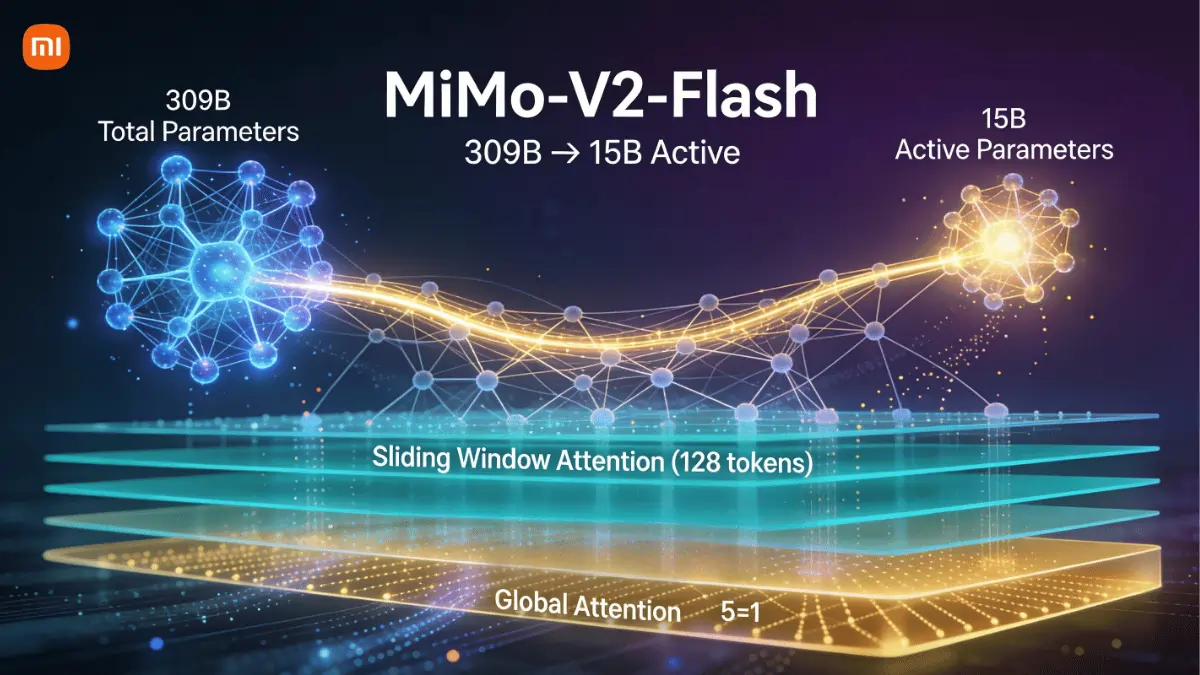
MiMo-V2-Flash is Xiaomi’s newly released open(-weight) large language model designed to hit a specific sweet spot: near-frontier capability for reasoning and coding while being much cheaper and faster to serve than dense models of comparable quality. It’s a Mixture-of-Experts (MoE) model with 309B total parameters, but only ~15B parameters active per token during inference—one of the classic MoE advantages: you can scale total capacity without paying full compute every time. Hugging Face+1
Where MiMo-V2-Flash tries to stand out is that it isn’t “just” another MoE checkpoint. Xiaomi positions it as an inference-centric foundation model—explicitly co-designed with deployment reality in mind (throughput, latency, KV cache pressure, long-context cost), and paired with early runtime support from projects like SGLang. LMSYS+1
2) Why MiMo-V2-Flash matters: the industry shift to inference-first models
Over the last two years, the open model ecosystem has learned a hard lesson: raw benchmark wins don’t always translate into real-world usability. The “hidden tax” is serving:
-
Prefill cost explodes at long context (attention can be quadratic).
-
KV cache becomes the bottleneck for batch size and throughput.
-
Decoding is often memory-bound; GPUs idle if you can’t keep them fed.
MiMo-V2-Flash’s design choices—hybrid sliding-window attention + multi-token prediction (MTP)—are basically a statement: optimize the expensive parts of inference first, then chase capability. LMSYS+1
This is also strategically aligned with Xiaomi’s broader push to ship AI experiences across devices (phones, tablets, and even EV software stacks), where cost and latency aren’t optional. The Indian Express
3) Core specs at a glance
From the official model card:
-
Architecture: Mixture-of-Experts (MoE)
-
Total parameters: 309B
-
Active parameters: 15B (per token)
-
Context window: up to 256K
-
Pretraining: 27T tokens, using FP8 mixed precision, with native 32k sequence length during training Hugging Face
-
Key inference features:
-
Hybrid attention (SWA + GA) with an aggressive window
-
Multi-token prediction (MTP) module to speed decoding Hugging Face+1
-
Availability is published through Xiaomi’s MiMo channels and Hugging Face. Hugging Face+1
Licensing note (important): The Hugging Face model card lists the model license as MIT. Meanwhile, the GitHub org page shows the MiMo-V2-Flash repository carrying an Apache-2.0 license (commonly for code). Treat weights vs repo code as potentially different licenses and follow the exact terms where you deploy. Hugging Face+1
4) The “Flash” in MiMo-V2-Flash: two architectural bets
A) Hybrid Sliding Window Attention (SWA + Global Attention)
Long-context is valuable, but full global attention across 100K+ tokens is brutal. MiMo-V2-Flash tackles this by interleaving local sliding window attention (SWA) with periodic global attention (GA) layers.
Key details reported by Xiaomi:
-
SWA and GA are interleaved at a 5:1 ratio (five SWA layers then one GA layer). Hugging Face+1
-
Window size is 128 tokens, intentionally aggressive. Hugging Face
-
This design cuts KV-cache storage by “nearly 6×” (per the model card). Hugging Face
-
Xiaomi also mentions a learnable attention sink bias to preserve long-context behavior even with the tight window. Hugging Face
Why this helps in practice:
-
Prefill speed improves because SWA reduces attention complexity from ~O(N²) toward ~O(N·w). LMSYS
-
KV cache becomes bounded by the window rather than growing with context length in the same way, enabling larger batches and better GPU utilization. LMSYS
In short: MiMo-V2-Flash is engineered so that “256K context” doesn’t automatically mean “256K cost catastrophe.”
B) Lightweight Multi-Token Prediction (MTP)
The second big bet is Multi-Token Prediction (MTP): instead of generating one token per decode step, the model uses a chain of prediction heads to draft multiple future tokens and then verify them efficiently.
From Xiaomi + LMSYS descriptions:
-
MiMo-V2-Flash uses multi-layer MTP (LMSYS notes 3 MTP layers). LMSYS
-
The model card describes the MTP module as lightweight (~0.33B params per block) using dense FFNs and SWA to keep overhead low. Hugging Face
-
Xiaomi claims MTP can triple output speed during inference in the intended setup. Hugging Face
This is closely related to the broader family of speculative decoding ideas, but Xiaomi emphasizes MTP as natively integrated for training and inference, not bolted on as a separate “draft model.” Hugging Face
5) Training and post-training: capability isn’t an afterthought
Speed is only half the story. MiMo-V2-Flash also describes an ambitious post-training stack aimed at reasoning and agents:
Efficient pre-training at scale
Xiaomi reports:
-
27 trillion tokens of training
-
FP8 mixed precision
-
“Native” 32k sequence length in pretraining
-
Then extended to 256k context support Hugging Face
These points matter because long-context and stable training at huge token counts are often where open models get shaky—especially when you later try to make them “agentic.”
Post-training: MOPD + agentic RL
Two items stand out on the model card:
-
Multi-Teacher On-Policy Distillation (MOPD) — framed as a distillation approach formulated like an RL process, using teacher guidance at the token level rather than only sequence-level rewards. Hugging Face
-
Scaling Agentic RL — Xiaomi claims large-scale agent reinforcement learning improves performance on “complex reasoning tasks” and agent benchmarks like SWE-Bench. Hugging Face
Even if you don’t buy every claim at face value, the direction is clear: Xiaomi isn’t optimizing only for chat; they’re optimizing for tool-using, multi-step work.
6) Benchmarks: what Xiaomi reports (and how to interpret it)
The model card includes extensive evaluation tables spanning general knowledge, math, coding, long-context tasks, and agentic benchmarks. A few highlights, as reported:
-
Long-context: Results reported up to 256K on NIAH-style evaluation, with strong performance retained at longer lengths. Hugging Face
-
Coding: Reported improvements on coding benchmarks and agent coding suites (including SWE-Bench variants). Hugging Face
-
Agentic: Strong reported scores on SWE-Bench Verified and other “agent” benchmarks after post-training. Hugging Face
Two practical takeaways for readers:
-
Prefer task-based evaluation (your repo, your stack, your prompts) over leaderboard obsession. A fast model that’s slightly weaker can outperform a “smarter” model if it lets you run 3× more iterations per hour.
-
Long-context quality varies by workload. A 256K window is amazing for codebase Q&A, log analysis, and retrieval-heavy pipelines, but your prompting and chunking strategy still determines whether that context is usable.
7) Serving MiMo-V2-Flash: why SGLang support matters
Big MoE models don’t become useful just because weights exist—you need runtime support that understands the model’s “tricks.”
LMSYS announced day-0 support in SGLang, highlighting:
-
Efficient execution for Sliding Window Attention (SWA)
-
Near-zero-overhead support for multi-layer MTP
-
A focus on balancing latency (TTFT/TPOT) and throughput on modern accelerators LMSYS
That’s a key point: MiMo-V2-Flash is intentionally built to benefit from these runtime optimizations; it’s not an incidental bonus.
A simple “getting started” path (conceptual)
Most teams will start with:
-
Pull weights from Hugging Face
-
Use an inference engine that supports SWA + MTP well (SGLang is explicitly called out) LMSYS+1
-
Set up a prompt template that matches Xiaomi’s intended “reasoning/agentic” usage, then measure:
-
Time-to-first-token (TTFT)
-
Tokens-per-output-time (TPOT)
-
End-to-end task completion rate (e.g., patch acceptance, test pass rate for code agents)
-
8) Real-world use cases where MiMo-V2-Flash can shine
Here are scenarios where MiMo-V2-Flash’s design is especially relevant:
1) High-throughput “agent factories”
If you run tool-using agents (browser + code runner + file edits), you often need many parallel rollouts. MTP + SWA can reduce the cost per rollout and increase throughput, which matters more than a small bump in single-response IQ. LMSYS+1
2) Codebase-scale assistance (long-context)
A 256K context window can fit:
-
multiple source files,
-
architecture docs,
-
error logs,
-
and test outputs
…without aggressive truncation. This is valuable for refactors, migration planning, and “why is this failing?” debugging sessions. Hugging Face
3) Reasoning-heavy back-office automation
Workflows like contract review drafts, compliance checklists, support macros, and analytics narratives often benefit from strong reasoning and low cost per generation—especially when you’re generating many variants and selecting the best.
4) On-device-to-cloud AI stacks
Xiaomi’s broader motivation appears to be shipping AI across products; MiMo-V2-Flash can act as a “cloud brain” for device agents where latency/cost constraints are strict. The Indian Express
9) Practical caveats (don’t skip these)
Even if the design is compelling, it’s still a 309B MoE model. Expect:
-
Hardware reality: You’ll likely need multi-GPU serving (and careful quantization strategy) for production throughput.
-
Ecosystem maturity: Because MTP + SWA are more specialized than vanilla transformer decoding, you’ll get the best results on runtimes that explicitly optimize them (again: SGLang is a headline example). LMSYS
-
Prompting differences: Some “thinking mode” / reasoning toggles and decoding settings can change results significantly (community chatter suggests users can accidentally nerf performance with the wrong mode), so build a small eval harness before committing. Reddit+1
10) How to evaluate MiMo-V2-Flash for your stack
If you’re deciding whether to adopt MiMo-V2-Flash, run a short, structured bake-off:
-
Pick 30–100 real tasks (tickets, PRs, support cases)
-
Measure cost + latency + task success, not just BLEU-style metrics
-
Include:
-
short prompts (chat)
-
medium tasks (multi-step reasoning)
-
long-context tasks (your largest docs / repos)
-
agent workflows (tool calls, patch + tests)
-
MiMo-V2-Flash is explicitly aimed at real-world serving tradeoffs—so evaluate it in the same terms. LMSYS+1
11) The big picture: Xiaomi’s entry into open foundation models
The release is notable beyond the model itself: Xiaomi is signaling that it wants to compete in the foundation-model era, not just consume models built by others.
As The Indian Express notes, MiMo-V2-Flash’s timing lines up with Xiaomi’s push toward agent-driven features across its ecosystem, and the model’s release across developer portals and Hugging Face positions it directly in the mainstream open model workflow. The Indian Express+1
From an ecosystem perspective, MiMo-V2-Flash also reinforces a trend: the next wave of “best” open models may not be the ones with the biggest parameter counts, but the ones that deliver the best tokens-per-dollar, tokens-per-second, and tasks-per-hour.
Conclusion
MiMo-V2-Flash is a strong example of where open LLMs are heading in late 2025: inference-aware, agent-ready, long-context capable, and optimized for the economics of real deployment.
The headline numbers—309B total / 15B active, 256K context, hybrid SWA/GA, and multi-layer MTP—aren’t just marketing bullets. They directly target the pain points that show up the moment you put a model behind an API and try to serve real users at scale. Hugging Face+1
If your workload is heavy on coding, reasoning, or agentic loops, MiMo-V2-Flash is worth serious evaluation—especially if you care as much about throughput and cost as you do about raw benchmark bragging rights.
For quick updates, follow our whatsapp –https://whatsapp.com/channel/0029VbAabEC11ulGy0ZwRi3j
https://bitsofall.com/c3-generative-ai-enterprise-genai-platform/
C3 AI Explained: How the Enterprise AI Platform Powers Large-Scale Business Intelligence