
MBZUAI Researchers Introduce PAN — A General World Model for Interactable, Long-Horizon Simulation
Summary (TL;DR): MBZUAI’s Institute of Foundation Models has released PAN, a world-model architecture that blends language-conditioned latent reasoning with high-fidelity video generation to produce long-horizon, action-conditioned simulations you can steer with natural language and step-by-step commands. PAN frames video generation as predictive simulation (a persistent latent world state + action updates), and shows notable gains on forecasting, planning, and agent-simulation benchmarks — a step toward building simulated environments that support planning, control, and embodied AI research. MBZUAI+2arXiv+2
Why PAN matters
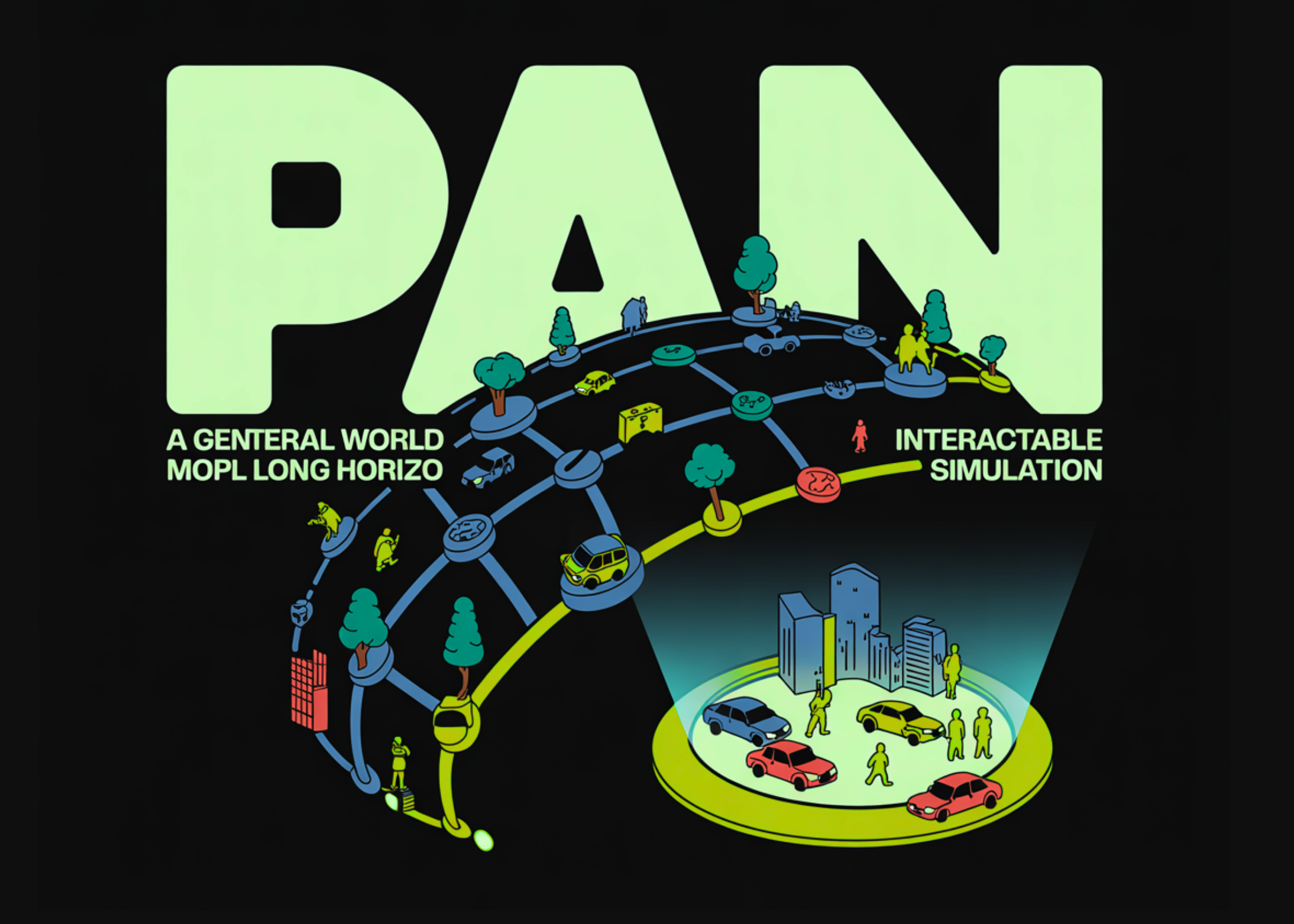
Most text-to-video systems today are optimized for short, photorealistic clips: they look impressive for a few seconds but often fail to remain consistent across many frames or to respond coherently when you try to control what happens next. PAN reframes the problem: rather than simply generating the next few frames, it learns a latent world state and models how that state evolves under actions, enabling multi-step, interactive simulations that can be queried or intervened upon by language or control signals. That shift — from short clip generation to simulative, action-conditioned world modeling — is what makes PAN interesting for robotics, planning, autonomous driving research, virtual testing, and interactive education. arXiv+1
High-level architecture — generative latent prediction (GLP)
At its core PAN implements what the authors call a Generative Latent Prediction (GLP) stack:
-
Perception & latent encoding: Visual observations (video frames) and optionally other modalities are encoded into a compact, multimodal latent representation built on a vision-language backbone (MBZUAI’s writeups mention Qwen2.5-VL as a central encoder in the production system).
-
Latent dynamics / reasoning: An LLM-style latent dynamics backbone operates in that latent space to predict future latent states conditioned on a sequence of actions or language queries. This is what lets PAN ‘reason’ about multi-step plans.
-
Video decoder / rendering: A high-fidelity video diffusion decoder (reported integrations include Wan2.1-T2V style diffusion) turns predicted latent trajectories back into pixels for visualization, using specialized denoising techniques that preserve temporal continuity.
This modular stack — perception, latent dynamics, decoder — means PAN can keep an internal, persistent representation of “world state” that persists across long rollouts and can be updated by actions or queries. MarkTechPost+1
Technical novelties that stabilize long-horizon rollouts
Two engineering ideas highlighted in MBZUAI’s reporting and the technical summary stand out:
-
Causal Swin DPM (chunk-wise causal denoising): Instead of regenerating frames independently or conditioning only on the immediate last frame, PAN’s decoder leverages a sliding, chunked causal denoising process. Each chunk conditions on partially noised past chunks so the decoder can maintain temporal consistency and avoid the temporal “drift” that plagues naive long-horizon diffusion rollouts. This helps PAN produce long, coherent sequences. MarkTechPost
-
Learned query embeddings + frozen LLM backbone for stability: The reported training protocol first adapts the diffusion decoder with flow-matching objectives, then jointly trains the GLP stack with a frozen multimodal LLM (the Qwen2.5-VL backbone in writeups) while learning task/query embeddings. This reduces catastrophic drift from end-to-end instability while still enabling language reasoning in latent dynamics. MarkTechPost+1
Those design choices are pragmatic: they reuse powerful production-scale building blocks while adding mechanisms specifically targeted at long-term simulation and action conditioning.
Datasets and scale
MBZUAI reports training PAN on large-scale video–action datasets spanning diverse domains (indoor robotics, driving, human-agent interactions, aerial/drone footage, etc.) so the model sees many styles of dynamics and control signals. The two-stage training reportedly required large compute budgets (the decoder adaptation phase notably used many H200 GPUs, per available press summaries), reflecting the practical cost of tuning high-resolution video decoders for causal denoising. MarkTechPost+1
Important note: while MBZUAI has published technical details and an arXiv preprint describing PAN’s architecture, training recipes, and benchmarks, full dataset release policies often lag model releases; users and researchers should check the project’s repo and license terms if they intend to reproduce results or use PAN for downstream tasks. arXiv+1
Benchmarks & empirical strengths
MBZUAI’s public writeups and coverage claim PAN achieves state-of-the-art results among open-source world models on several metrics important to simulation:
-
Action-conditioned simulation fidelity (how well an agent’s intended actions produce correct outcomes over time),
-
Long-horizon forecasting (maintaining consistency and plausible dynamics many seconds/minutes into the future), and
-
Simulative planning metrics (usefulness of rollouts for downstream decision making, e.g., planning or policy evaluation).
Reported numbers in media coverage and the project summary show competitive scores (examples include agent-simulation and environment consistency percentages cited in early writeups), and PAN is described as “remaining competitive” with some closed commercial systems while offering more transparent benchmarks and ablations. That said, cross-model comparisons depend heavily on datasets, evaluation definitions, and rollout lengths — so these headline numbers are a good directional indicator rather than an absolute ranking. MarkTechPost+1
Example capabilities (what you can actually do with PAN)
Based on demos and descriptions, PAN supports:
-
Language-conditioned multi-step instructions: e.g., “navigate the car to the left lane, then slow to 30 km/h and stop beside the curb,” producing a coherent simulated video that reflects the instruction sequence.
-
Action sequences and intervention: you can inject or edit actions mid-rollout (e.g., changing an agent’s goal after several timesteps) and obtain updated simulated futures.
-
Longer rollouts with fewer artifacts: thanks to the GLP approach and causal denoising, PAN’s outputs reportedly maintain object permanence, consistent lighting/geometry, and agent identity across longer sequences than typical text-to-video models.
-
Simulative planning for agents: the internal latent rollouts can be used as predicted futures for planning controllers — meaning PAN can, in principle, serve as a simulation environment for training or testing policies where running a physical system is expensive or risky. MBZUAI+1
These features make PAN appealing for development workflows where researchers need fast, cheap rollouts of “what-if” scenarios under language or control prompts.
Potential applications
-
Robotics and control research: faster iteration on policies by validating multi-step plans in visually realistic simulated rollouts.
-
Autonomous driving & ADAS development: scenario generation, edge-case synthesis, and testing how agents respond to rare events without risking real vehicles.
-
Virtual training and education: immersive simulations that respond to trainee actions and instructions for pilot training, hazard drills, or surgical rehearsal.
-
Game development & interactive storytelling: dynamic NPC behavior and persistent worlds that can be steered via narrative commands.
-
Scientific simulation & visualization: exploratory, visually coherent demonstrations of physical dynamics where a compact learned world model can help hypothesize outcomes. Forbes+1
Limitations, risks, and open challenges
PAN is an important step, but it’s not a silver bullet. Key challenges and risks include:
-
Reality gap: a learned world model can simulate plausible futures but may still diverge from real physics or edge cases, which is critical when transferring policies to the real world (sim2real gap). Relying exclusively on learned simulation for control could be risky without careful validation. arXiv
-
Biases in training data: if the video–action datasets underrepresent certain environments, agent types, or conditions, PAN’s rollouts will inherit those blind spots.
-
Computation & accessibility: training and adapting the diffusion decoder and GLP stack requires large compute, which may limit reproducibility for smaller labs. MBZUAI’s demo and open materials may mitigate this, but practical reuse will depend on release artifacts. MarkTechPost
-
Safety & misuse: interactive world models can be used for benign research but also for creating deeply realistic fabricated sequences (misinformation risks) or for automating tasks that could have safety or ethical implications if not carefully constrained. Responsible release, watermarking, and policy controls should accompany such models. Forbes
How PAN fits into the broader “world model” landscape
PAN is part of a broader research push to move beyond one-shot generative models toward world models — systems that maintain an internal state and can be queried, acted upon, and used for planning. Compared to other recent efforts (video generators, JEPA/latent predictive models, or more classical simulators), PAN’s distinguishing features are (1) explicit action conditioning; (2) a multimodal latent representation shared with an LLM-style dynamics backbone; and (3) a production-scale decoder adapted for causal, chunked denoising. In that sense PAN is a practical demonstration of how to unify large multimodal backbones with modern video decoders to operationalize long-horizon simulation. arXiv+1
What MBZUAI released and next steps
MBZUAI has published an arXiv preprint describing PAN’s architecture, training, and benchmark results, and the university’s communications include explainer pieces and demos illustrating PAN’s interactivity. News coverage (Forbes, Khaleej Times, Marktechpost, and MBZUAI’s own newsroom) highlights both the technical contributions and the strategic significance — the UAE’s continued investment in producing frontier AI research and tooling. Future directions likely include broader empirical evaluations, more robust sim2real transfer experiments, and potential public toolkits for agent-in-the-loop experimentation. Researchers should consult MBZUAI’s project page and the arXiv paper for reproducible experiments, benchmarks, and code/dataset links as they become available. arXiv+2MBZUAI+2
Concluding thoughts
PAN represents an important pivot in generative AI: from making good-looking short clips to building models that can think about the world forward in time under actions. That pivot matters because it brings generative modeling closer to the core problems of planning, control, and embodied intelligence. MBZUAI’s blend of multimodal LLMs, latent dynamics, and diffusion decoders — plus the engineering work to stabilize long rollouts — offers a concrete recipe other labs will study, reproduce, and extend.
If you’re a researcher in robotics, autonomous systems, or interactive media, PAN is worth reading about and experimenting with when MBZUAI releases code and checkpoints. If you’re a policy maker or product manager, PAN signals that the frontier of simulation is moving fast — which raises both exciting opportunities and real responsibilities around safety, evaluation, and public benefit. arXiv+1
Sources & further reading
-
MBZUAI newsroom: “How MBZUAI built PAN, an interactive, general world model capable of long-horizon simulation.” MBZUAI
-
MBZUAI / arXiv preprint: PAN: A World Model for General, Interactable, and Long-Horizon Simulation (arXiv preprint). arXiv
-
MarkTechPost overview and breakdown of PAN’s components and metrics. MarkTechPost
-
Forbes analysis: “The PAN World Model From MBZUAI Aims To Elevate AI Simulation.” Forbes
-
Khaleej Times coverage on MBZUAI’s PAN and its implications for simulated futures. Khaleej Times