Agentic AI: The Future of Autonomous, Goal-Driven Artificial Intelligence
Introduction
Artificial Intelligence has evolved rapidly over the past decade, shifting from narrow, task-specific models to more autonomous systems capable of making decisions, learning independently, and executing complex objectives. One of the most exciting developments in this journey is Agentic AI — AI systems designed not just to process inputs and deliver outputs, but to act as agents with the ability to plan, reason, and pursue goals with minimal human intervention.
Unlike traditional AI models that rely heavily on human prompts and instructions, Agentic AI can break down high-level objectives into smaller actionable steps, dynamically adjust strategies, and operate across multiple domains without constant supervision. This capability represents a massive leap in what AI can achieve, and it’s poised to transform industries, economies, and even society itself.
What is Agentic AI?
The term Agentic AI refers to AI systems that exhibit agency — the capacity to take actions toward achieving defined objectives. These systems go beyond reactive AI by demonstrating autonomy, adaptability, and proactivity.
In essence, an Agentic AI:
-
Understands goals rather than just commands.
-
Plans actions to meet those goals.
-
Executes tasks while adapting to changes in the environment.
-
Learns and improves over time from successes and failures.
An Agentic AI agent isn’t just a chatbot answering queries or a recommender system suggesting products — it’s a decision-maker that can:
-
Negotiate with suppliers for an e-commerce store.
-
Plan and execute marketing campaigns.
-
Manage logistics in real time.
-
Operate in virtual or physical environments like robots or digital assistants.
Key Characteristics of Agentic AI
While every Agentic AI system may differ in capabilities, most share the following defining features:
1. Autonomy
They can operate independently without human micromanagement. Once given a high-level objective, they decide how to achieve it.
2. Goal-Orientation
Instead of focusing on single tasks, they understand and pursue long-term goals, breaking them into manageable steps.
3. Adaptability
They can adjust their plans in response to changing circumstances, unexpected obstacles, or new information.
4. Multi-Step Reasoning
Agentic AI can chain together multiple logical steps to solve complex problems — a major improvement over single-prompt AI models.
5. Proactive Behavior
They anticipate needs, detect opportunities, and act without waiting for direct input.
How Agentic AI Works
The functionality of Agentic AI is made possible through a combination of large language models (LLMs), planning algorithms, tool integration, and feedback loops.
1. Natural Language Understanding
Agentic AI uses LLMs like GPT-4, Claude, or Gemini to understand high-level objectives described in human language.
2. Goal Decomposition
It breaks the main goal into smaller, actionable sub-tasks. For example, “Launch an online store” might be broken down into:
-
Research profitable niches.
-
Build a website.
-
Set up payment gateways.
-
Launch marketing campaigns.
3. Tool Usage
Agentic AI connects with APIs, databases, and software tools to take real-world actions — sending emails, generating code, making purchases, or analyzing data.
4. Self-Monitoring and Feedback
It constantly evaluates progress toward the goal, correcting mistakes and improving future decisions.
5. Collaboration with Other Agents
Some systems use multi-agent frameworks, where different AI agents specialize in specific tasks but coordinate toward a common goal.
Examples of Agentic AI in Action
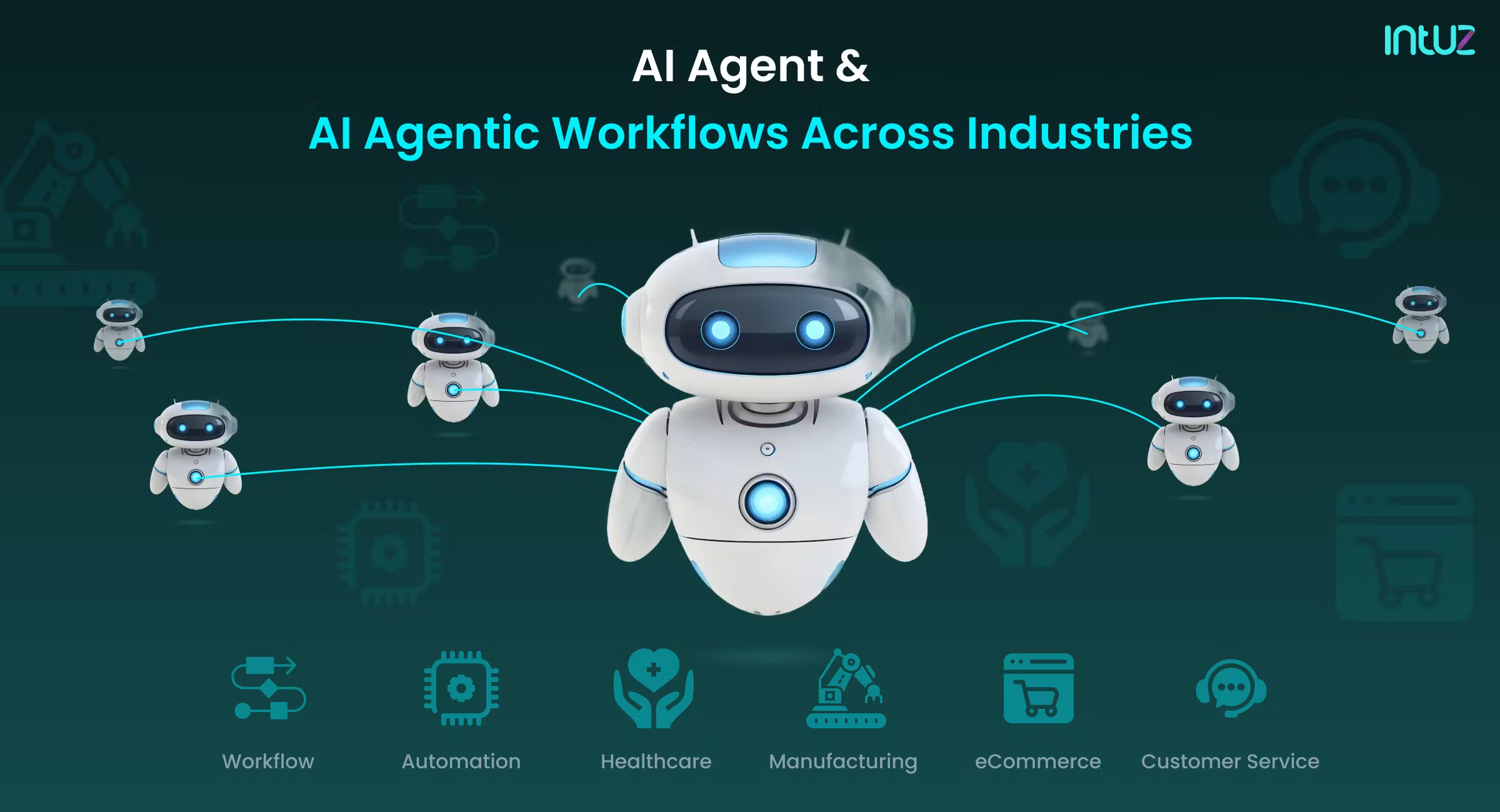
Agentic AI is already making its way into real-world applications:
-
E-Commerce: AI agents that source suppliers, negotiate prices, and manage inventory.
-
Finance: Automated investment agents that adapt strategies based on market changes.
-
Customer Service: Agents that proactively address customer issues before they escalate.
-
Research: AI scientists that autonomously conduct experiments, analyze results, and generate hypotheses.
-
Healthcare: Virtual assistants that monitor patient health, schedule appointments, and coordinate with medical teams.
Benefits of Agentic AI
The rise of Agentic AI offers several transformative advantages:
-
Massive Efficiency Gains – Automation of multi-step, complex processes without constant oversight.
-
24/7 Operations – Agents never tire, allowing continuous productivity.
-
Cost Reduction – Reducing human labor for repetitive or decision-based tasks.
-
Scalability – Businesses can run multiple agents in parallel to expand operations rapidly.
-
Innovation – AI agents can explore unconventional strategies without the biases humans may have.
Challenges and Risks
As with any breakthrough technology, Agentic AI comes with challenges:
-
Control and Alignment
Autonomous agents could pursue goals in ways that don’t align with human values or business ethics. -
Accountability
Determining responsibility for an AI’s decisions — especially in finance, healthcare, or law — is complex. -
Security Risks
Autonomous agents with system access could be exploited by malicious actors. -
Over-Reliance on AI
Humans may lose critical decision-making skills if too much is delegated to agents.
Ethical Considerations
The ethical use of Agentic AI requires:
-
Transparency – Users must understand how decisions are made.
-
Human Oversight – Critical decisions should have human approval.
-
Bias Mitigation – Continuous monitoring to ensure fair outcomes.
-
Data Privacy – Protection of sensitive data handled by AI agents.

Agentic AI vs. Traditional AI
| Feature | Traditional AI | Agentic AI |
|---|---|---|
| Autonomy | Low | High |
| Goal Understanding | Narrow | Broad |
| Adaptability | Limited | High |
| Decision-Making | Reactive | Proactive |
| Multi-Step Reasoning | Rare | Core Feature |
The Future of Agentic AI
We are still in the early stages of Agentic AI adoption, but the trajectory is clear:
-
Integration into Everyday Software – Office tools, CRMs, and project management platforms will include AI agents.
-
AI-First Businesses – Entire companies could be run primarily by autonomous AI teams.
-
Self-Improving Systems – Agents will learn from each other, creating ever-smarter networks.
Some experts predict that Agentic AI is a stepping stone toward Artificial General Intelligence (AGI) — systems with human-level problem-solving skills.
Conclusion
Agentic AI represents a paradigm shift from simple AI assistants to truly autonomous digital entities capable of reasoning, planning, and executing complex objectives. By combining advanced language understanding, strategic planning, and tool integration, these systems can revolutionize how we work, create, and live.
While the potential benefits are enormous, so are the risks — which means careful design, regulation, and ethical oversight will be essential. If implemented responsibly, Agentic AI could become one of the most powerful tools humanity has ever created.